How to Choose the Right Japanese Translation Agency for Your Business in 2026
Entering the Japanese market is a high-stakes move. With the world’s fourth-largest GDP, the rewards for success are immense, but so are the risks of communication failure. Japan is not just linguistically distinct; it is a high-context culture where how you say something matters just as much as what you say.
For global enterprises, a literal translation of marketing materials or legal documents is often the fastest route to misunderstanding—or worse, damaging your brand’s reputation. This is why selecting the right Japanese translation agency is not merely an administrative task; it is a strategically critical decision. You don’t just need a vendor who can translate English into Japanese; you need a partner who understands local nuance, business etiquette, and market psychology.
In this guide, we will explore why business success in Japan requires more than just fluency. We will outline the essential criteria for choosing an agency that acts as your bridge to the Japanese consumer, ensuring your message resonates, converts, and builds lasting trust.
- Selection criteria — Five non-negotiable standards for choosing a qualified Japanese translation agency
- Cultural complexity — Why Keigo, high-context communication, and tone adaptation are essential in Japanese
- Service types — The range of services available, from certified document translation to website localization
- Pricing structure — Standard cost tiers and turnaround timelines for professional Japanese translation in 2026
TOC
Why Japanese Translation Requires Cultural and Contextual Expertise
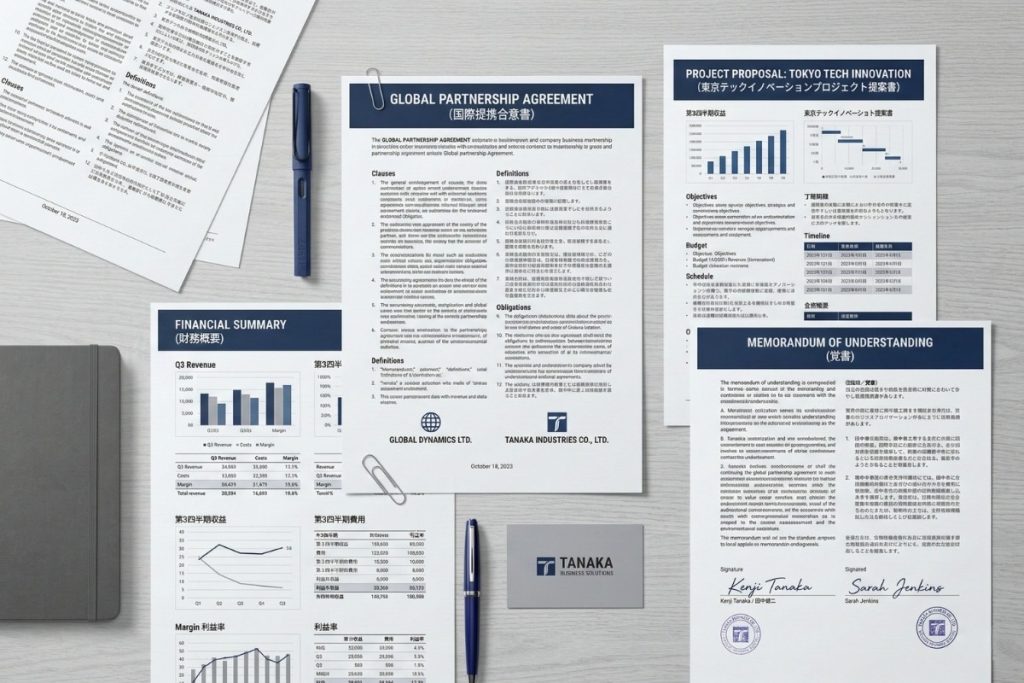
Japanese is frequently cited by the U.S. Department of State as one of the most difficult languages for English speakers to master. However, the challenge for global businesses isn’t just the grammar or the three different writing systems (Hiragana, Katakana, Kanji). The real hurdle lies in the cultural framework that shapes how language is used. A literal translation might be grammatically correct but socially disastrous. To succeed in Japan, your message must navigate complex social hierarchies and unspoken rules.
Understanding Keigo: The Role of Honorifics in Japanese Business Communication
In Western business culture, communication tends to be egalitarian and direct. In Japan, language changes based on who you are speaking to and their relative status. This system is known as Keigo. Sonkeigo (Respectful Language) is used to elevate the status of the customer or superior. Kenjougo (Humble Language) is used to lower your own status when speaking about yourself or your company. Teineigo (Polite Language) is the standard polite form used for general neutrality.
Using the wrong level of politeness is not just a mistake; it signals a lack of respect or education. For a foreign brand, failing to use correct Keigo in B2B correspondence or customer support can instantly erode trust, making you look like an unreliable partner.
Japan as a High-Context Culture: Why Direct Translation Fails
Japan is considered a High-Context culture, whereas the US and much of Europe are Low-Context. In Low-Context cultures, communication is explicit: Yes means yes, and No means no. In Japan’s High-Context culture, much of the meaning is conveyed through silence, tone, and shared understanding—what is not said is often more important than what is said. This concept is called Kuuki wo yomu (reading the air).
A literal translation of a persuasive English sales pitch often sounds aggressive or pushy to a Japanese audience. A skilled Japanese translation agency doesn’t just translate words; they adapt the tone to ensure your bold message is received as confident and reliable rather than arrogant.
Why Machine Translation Falls Short for Japanese Business Content
With the rise of AI, many companies are tempted to use automated tools. While useful for rough drafts, they remain risky for external Japanese communication. Japanese sentences frequently omit the subject because it is understood from context. Machines often infer the missing subject incorrectly, leading to confusing or nonsensical statements. Furthermore, AI struggles to detect the subtle emotional nuance required for effective marketing copy in Japan. Reliance on raw machine translation signals to your Japanese partners that you are not serious about the market.
The 5 Essential Criteria for Choosing a Japanese Translation Agency
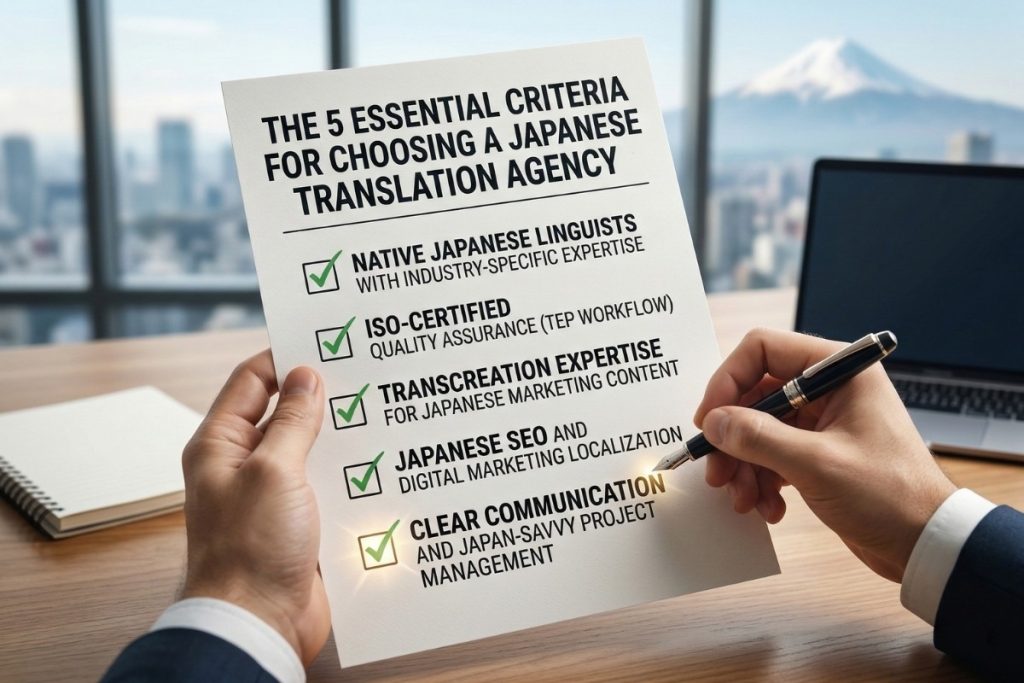
When your brand’s reputation is on the line, choosing a translation partner is not just about price—it’s about risk management. To ensure your entry into the Japanese market is seamless, look for these five non-negotiable criteria in any potential agency.
Native Japanese Linguists with Industry-Specific Expertise
Fluency is the baseline, not the differentiator. A top-tier agency employs native Japanese speakers who ideally reside in Japan. Language evolves rapidly; a translator who left Japan 20 years ago may use outdated terminology or miss current slang and cultural references. Furthermore, ensure the linguists have Subject Matter Expertise (SME). Legal contracts require a translator with a background in law, while medical devices need someone with life sciences training. A generalist cannot accurately convey the nuance of a patent or a technical specification.
ISO-Certified Quality Assurance (TEP Workflow)
Never settle for a single-translator workflow. Professional agencies adhere to international quality standards like ISO 17100. This mandates a rigorous TEP (Translation, Editing, Proofreading) process. Translation is done by a native subject matter expert. Editing involves a second senior linguist checking for accuracy, style, and consistency against the source. Proofreading is a final review focused on flow, formatting, and typos before delivery. This multi-layered approach ensures that errors are caught before they reach your customers.
Transcreation Expertise for Japanese Marketing Content
For slogans, advertisements, and website headers, literal translation often fails. You need Transcreation (Translation + Creative adaptation). Transcreation focuses on adapting the emotional intent and impact of the message rather than the exact words. For example, a punchy three-word English slogan might need to be completely rewritten to evoke the same feeling in Japanese, or it might be better left in English (Katakana) to sound cool and modern. An agency without transcreation capabilities will struggle to make your brand appeal to Japanese consumers.
Japanese SEO and Digital Marketing Localization
If you are translating a website, you want it to be found. However, high-volume keywords in English often do not have direct equivalents in Japanese. A direct translation of a keyword might have 0 monthly searches in Japan, while a synonym you didn’t think of has 10,000. A strategic agency will perform multilingual keyword research to identify what your Japanese customers are actually typing into Google, ensuring your content is primed for organic traffic from day one.
Clear Communication and Japan-Savvy Project Management
The Japanese market moves at a specific pace—often slower in decision-making but faster in execution once decided. Your agency should act as a cultural bridge, managing expectations on both sides. Look for a partner who offers clear timelines, dedicated project managers, and transparent pricing structures, so you are never left guessing about the status of your launch.
Japanese Translation and Localization Services Overview

Understanding what services are available is the first step in determining whether an agency can meet your specific needs. A full-service Japanese translation partner should offer a range of capabilities beyond simple document conversion.
Professional Japanese Document Translation Services
From technical manuals to corporate communications, document translation forms the foundation of any localization effort. Professional agencies handle business contracts, financial reports, HR materials, and product specifications with industry-specific terminology and formatting standards. Each document type requires unique expertise—what works for a marketing brochure will fail for a regulatory submission.
Certified Japanese Translation for Legal and Official Documents
When dealing with government agencies, courts, or official institutions in Japan, certified translations are mandatory. These include birth certificates, marriage licenses, academic transcripts, patents, and immigration documents. A certified translator must be qualified and often registered with professional bodies such as the American Translators Association (ATA) or hold equivalent Japanese credentials. The certification attests that the translation is a true and accurate representation of the original document.
Japanese Website and App Localization (UI/UX, SEO, Mobile Optimization)
Digital localization goes far beyond translating web copy. It involves adapting UI/UX elements, adjusting layouts for Japanese text expansion, implementing proper character encoding, and ensuring that date formats, currency symbols, and payment gateways align with local expectations. In 2026, mobile-first design is critical in Japan, where smartphone penetration exceeds 90%. Your agency must test the localized interface across devices to prevent broken layouts or functionality issues.
The scale of Japan’s smartphone adoption becomes clear when you look at the latest data:
- Smartphone ownership rate: 98% of all mobile phone owners in Japan use a smartphone (as of January 2025)
- Household smartphone penetration: 90.5%; individual ownership: 80.5% (as of August 2024)
- 74.4% of individuals access the internet via smartphone, vs. 46.8% via PC — a gap of 27.6 percentage points (2024 data)
- Daily smartphone contact time: 165.1 minutes (all-time high, up 3.4 min. year-on-year) (survey: Jan–Feb 2025)
- 92.6% of Japan’s internet users are active LINE users — approximately 99 million monthly active users (late 2025)
- Median mobile download speed: 60.37 Mbps (+27.3% year-on-year, as of August 2025)
- Cashless payment ratio: 42.8% in 2024, surpassing the government’s 40% target; national goal is 80% by 2030
Japanese Video Localization: Subtitling and Voice-Over
Video content is dominates in the Japanese market, especially on platforms like YouTube and LINE. Subtitling requires precise timing and reading speed considerations, as Japanese text density differs significantly from English. Voice-over services must match the emotional tone and pacing of the original, using native voice actors who understand the target demographic. For corporate training videos or marketing campaigns, professional voice work elevates credibility and engagement.
Japanese Interpretation Services (Simultaneous & Consecutive)
For live events, business negotiations, and conferences, interpretation services are essential. Simultaneous interpretation is used in large conferences where interpreters work in real-time from soundproof booths. Consecutive interpretation is common in business meetings, where the interpreter speaks after the original speaker pauses. Both require exceptional linguistic skill and deep cultural knowledge to convey not just words but intent and emotion.
Japanese Translation Timelines and Turnaround Expectations

Time management is critical when entering a new market. Understanding realistic timelines helps you plan product launches, legal filings, and marketing campaigns without costly delays.
Standard Project Timeline Breakdown
For a typical 5,000-word business document, expect a 5-7 business day turnaround with a full TEP process. Website localization projects with 10,000-15,000 words generally require 2-3 weeks, including design integration and testing. Technical manuals with specialized terminology may extend to 3-4 weeks depending on complexity and the need for subject matter expert review. Video subtitling averages 3-5 business days per hour of content, while voice-over projects add an additional week for recording and post-production.
Rush and Express Service Options
Many agencies offer expedited services for urgent needs. Rush delivery (24-48 hours) is possible for shorter documents under 2,000 words but typically incurs a 50-100% premium. However, rushing compromises quality assurance steps. For mission-critical content, it’s always better to plan ahead. Emergency interpretation services are often available with 24-hour notice, though premium rates apply and interpreter availability cannot always be guaranteed.
Why You Need a Japanese Market Entry Partner, Not Just a Translator

Many global firms view a translation agency as a final step in their production line. However, to truly penetrate the Japanese market, translation should be the beginning of a broader strategy. This is where the distinction between a vendor and a Market Entry Partner becomes clear.
Localization vs. Translation: What Matters in the Japanese Market
Localization is the process of adapting a product or content to a specific locale or market. In Japan, this involves more than just text. It includes visual aesthetics, as Japanese web design often favors more information-dense layouts compared to the minimalist Western style. It also includes functional adaptation such as adjusting date formats, currency symbols, and payment methods like Konbini payments. UX/UI sensitivity is also critical, ensuring that Japanese characters don’t break your website’s layout or compromise usability.
Market Research and Sales Support for Japan Market Entry
A beautifully translated brochure is a wasted investment if it never reaches the right hands. The most successful entrants into Japan recognize that localization without market intelligence is a gamble. At this stage, you need a partner who can provide competitor analysis, sales representation, and digital marketing execution. In Japan, B2B relationships are built on trust. Having a local team that can act as your sales arm is a game-changer for overseas companies without a physical office.
Cultural Intelligence (CQ) Training for Japanese Business Success
Success in Japan isn’t just about how your customers see you; it’s about how your team interacts with Japanese stakeholders. Cultural Intelligence (CQ) training prepares your HQ staff to understand Japanese business etiquette such as Meishi exchange, decision-making hierarchies, and Nemawashi—the process of quietly laying the foundation for a proposed change. An agency that offers CQ training ensures that the bridges built by professional translation aren’t burned by cultural misunderstandings.
Industry-Specific Japanese Localization (Tech, Manufacturing, Life Sciences)

In the Japanese market, a one-size-fits-all translation strategy is a recipe for mediocrity. Different sectors demand vastly different linguistic styles, compliance standards, and cultural sensitivities.
A. Software and SaaS (The Tech-First Approach)
For global tech firms, localization is not just about words; it is about user experience. Japanese text often takes up more vertical space and less horizontal space than English. If your agency doesn’t understand CSS or UI constraints, translated strings will break buttons and menus. The balance between Katakana and native Japanese kanji is a specialized skill. With the rapid update cycles of 2026, your partner must integrate with platforms like GitHub or Lokalise to ensure real-time Japanese updates.
B. Manufacturing and Engineering (The Precision Requirement)
Japan’s manufacturing sector is world-renowned for its obsession with detail. Terminology management is crucial to prevent operational errors. A top agency uses Translation Memory and Glossaries to ensure 100% consistency across thousands of pages. Translating JIS (Japanese Industrial Standards) and ensuring that safety warnings meet local legal requirements is critical for risk mitigation.
C. Life Sciences and Healthcare (The High-Stakes Field)
Translating for the Japanese healthcare market is a matter of life and death, and it is heavily regulated by the PMDA (Pharmaceuticals and Medical Devices Agency). This field requires accuracy over creativity. There is no room for interpretation when translating clinical trial data or dosage instructions. Your agency must be familiar with the latest 2026 medical regulations in Japan to ensure that your labeling and documentation are submission-ready.
Japan Market Trends 2026: Insights for Global CMOs
The Japanese market in 2026 is significantly different from even five years ago. To sound authentic, your content must reflect these modern realities.
The AI-Human Hybrid Era
By 2026, AI translation has become a commodity. However, the Japanese consumer’s detector for unnatural, AI-generated content has also become sharper. Content that is almost correct but lacks human warmth is often ignored in Japan. We focus on Post-Editing by High-Level Experts (PEHLE), where the AI does the heavy lifting, but a human expert injects the brand’s unique soul and cultural nuance back into the text.
Digital Transformation (DX) and Search Behavior
The way Japanese users search has evolved. While Google remains dominant, Yahoo! JAPAN and SNS-based search on LINE and Instagram play a massive role in the B2B and B2C buyer’s journey. In 2026, voice search and natural language queries are more common. A strategic translation agency performs SEO research that accounts for how Japanese professionals actually speak into their devices, not just what they type.
The Sustainability (SDGs) Imperative
Japanese corporations are now among the world’s most aggressive pursuers of SDGs. If your corporate profile or CSR report is not translated with the specific vocabulary of Japanese sustainability, you will be at a disadvantage during the procurement process with major Japanese firms.
Japanese Translation Pricing in 2026: Cost Tiers and Fair Market Rates

Professional Business Translation remains a premium service because of the liability and brand value involved. Tier 1 High-End Transcreation for brand taglines and marketing typically ranges from $0.25 to $0.40 per word. Tier 2 Professional Business (TEP) for websites and legal contracts ranges from $0.16 to $0.20 per word. Tier 3 Expert MTPE (Post-Editing) for large-scale FAQs ranges from $0.09 to $0.12 per word. Rates vary based on technical complexity, urgency, and industry specialization.
Volume discounts apply for projects exceeding 50,000 words. Translation Memory leverage can reduce costs by 15–30% on repeated content. Interpretation services range from $500-$1,200 per day for consecutive interpretation and $1,000-$2,500 per day for simultaneous interpretation with specialized equipment.
| Item | After |
| Tier 2 (TEP) | $0.16–$0.20 |
| Tier 3 (MTPE) | $0.09–$0.12 |
| TM cost reduction | 15–30% |
| Tier 1 (Transcreation) | No change |
| Interpretation fees | No change |
How to Request a Japanese Translation Quote (What to Prepare)

Beginning your Japanese market journey should be straightforward and transparent.
What Information You Need to Provide
To receive an accurate quote, prepare the following: the source document or URL, target language (Japanese variants if applicable), desired delivery date, intended use (marketing, legal, technical), any specific terminology or style preferences, and whether certification is required. The more context you provide, the more accurate the estimate and timeline.
Our Response Time and Onboarding Process
Most professional agencies respond to quote requests within 24 hours. During onboarding, expect a kick-off meeting where you’ll meet your dedicated project manager, review terminology and style preferences, establish communication protocols, and set clear milestones and deliverables. Transparency and regular updates ensure you’re never left wondering about project status.
Japanese Language Quick Reference for Businesses
While professional translation is essential for official communication, understanding basic Japanese business etiquette and phrases demonstrates respect and cultural awareness.
Essential Business Phrases in Japanese
Yoroshiku onegaishimasu (よろしくお願いします) – “Please treat me favorably” (used when starting business relationships). Osewa ni natte orimasu (お世話になっております) – “Thank you for your continued support” (email opening). Gokurousama deshita (ご苦労様でした) – “Thank you for your hard work” (to subordinates). Otsukaresama deshita (お疲れ様でした) – “Thank you for your hard work” (to colleagues/superiors).
Common Mistakes to Avoid in Japanese Business Communication
Never use casual language in initial business correspondence. Always use the recipient’s title (e.g., Tanaka-san, not just Tanaka). Avoid direct refusals; instead use softening phrases like “It might be difficult” (muzukashii desu). Never rush to a decision; Japanese business culture values consensus-building. When presenting business cards (meishi), use both hands and take time to read the card carefully before putting it away respectfully.
Common Pitfalls to Avoid When Hiring an Agency
Choosing the wrong partner can lead to bad grammar, missed deadlines, and a damaged brand image. Focusing solely on cost per word often indicates a reliance on unedited machine translation. Overlooking the review phase can lead to a lack of brand voice consistency. Ignoring the need for ongoing support will lead to problems as you scale your Japanese presence. Failing to verify native speaker credentials can result in awkward, unnatural translations that harm credibility.
AtGlobal: Your One-Stop Solution for Japan Market Entry
At AtGlobal, we pride ourselves on being more than just a Japanese translation agency. We are a specialized consultancy designed to bridge the gap between global innovation and the unique Japanese market. Our strength lies in our comprehensive, end-to-end support system. We empower your entire business strategy through high-end localization, strategic market research, sales and digital marketing representation, and CQ (Cultural Intelligence) coaching. Whether you are a tech giant or a B2B firm seeking your first Japanese client, AtGlobal provides the expertise to turn your market entry goals into a measurable success.
Japanese Translation FAQ (Common Questions from Global Companies)
- How long does it take to translate a website into Japanese?
-
For a standard 10,000-word corporate site, expect 2–3 weeks for a full TEP process. Marketing-heavy sites requiring transcreation may take longer.
- Can we just use ChatGPT or DeepL for our Japanese entry?
-
For gisting internal emails, yes. For customer-facing content, no. AI still struggles with Japanese honorifics and context, which can make your brand look unprofessional.
- Do you support SEO in Japanese?
-
A top agency should. This includes translating meta tags, optimizing image alt-text, and selecting keywords based on Japanese search volume, not just English direct translations.
- What is ISO 17100, and do I need it?
-
ISO 17100 is the international standard for translation services. Choosing an ISO-certified agency ensures they follow a strict, audited process for quality control and translator qualifications.
- What payment methods are commonly used in Japan?
-
Beyond credit cards, Japan heavily uses Konbini payments (convenience store payments), bank transfers, and digital wallets like PayPay. Your e-commerce loca
- How do I know if my translator is truly native?
-
Ask about their education, where they currently reside, and request work samples. Native speakers who live in Japan stay current with language evolution and cultural trends.
Conclusion: How to Choose the Right Japanese Translation Agency
- Japanese translation requires cultural adaptation beyond grammar — honorifics (Keigo) and high-context communication must be handled correctly
- Native Japanese linguists residing in Japan with subject matter expertise are essential for accurate, up-to-date translations
- ISO 17100-certified agencies follow a mandatory TEP (Translation, Editing, Proofreading) process to ensure quality
- Transcreation is necessary for marketing content where literal translation fails to convey the intended emotional impact
- Multilingual SEO research is critical — direct keyword translations often have zero search volume in Japan
- Machine translation (AI/DeepL) is risky for customer-facing content due to its inability to handle honorifics and cultural nuance
- Full localization (L10n) covers UI/UX, date formats, payment methods (e.g., Konbini), and mobile-first design for Japan’s 90%+ smartphone penetration
- Translation Memory (TM) and CAT tools reduce costs by 20–40% on recurring projects while maintaining brand consistency
- 2026 pricing ranges from $0.10–$0.40 per word depending on tier (MTPE, professional TEP, or high-end transcreation)