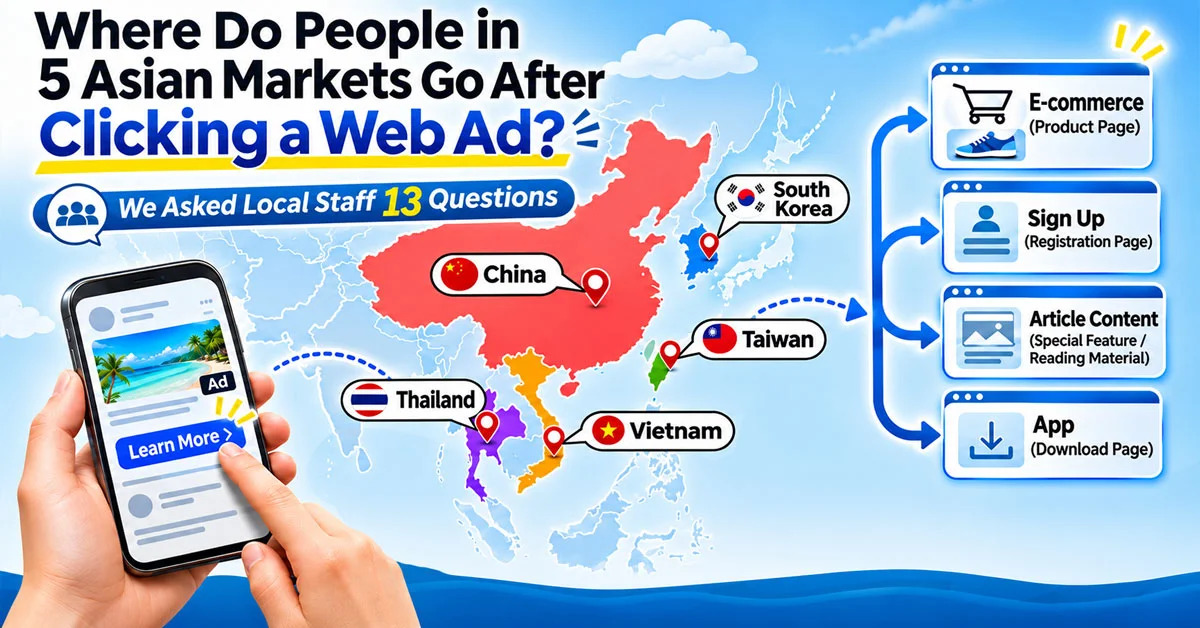
Where Do People in 5 Asian Markets Go After Clicking a Web Ad? We Asked Local Staff 13 Questions
We asked AtGlobal colleagues in China, South Korea, Vietnam, Thailand and Taiwan (one to three respondents per market) 13 questions about what they do after seeing a web ad. In all five markets, our respondents do not reach Japanese companies’ websites in their everyday shopping. In South Korea, all three generations start shopping on Coupang. In Vietnam, a chat reply that takes 15 minutes is already too slow. Here is how the five markets differ, plus five things to fix before you spend more on ads.
When a Japanese company advertises abroad, it usually pictures the same path. Someone sees the ad, taps it, lands on the company website and types their contact details into the inquiry form.
Most companies track impressions and click-through rates closely. Few check what happens after the tap.
So we asked AtGlobal, Ltd. staff in five Asian markets (China, South Korea, Vietnam, Thailand and Taiwan) to answer a 13-question survey and send us screenshots from their phones. We did not ask which ad platform is strongest. We asked what happens between seeing an ad and handing a company your contact details, or deciding not to.
When we lined the answers up, one stood out because all five markets gave it. We asked, “Tell us about a moment when you opened a Japanese company’s website and closed it, thinking ‘this won’t work.'” In all five markets, the answer was the same: “I’ve never had that experience.”
That is not because people dislike Japanese companies. In their everyday shopping, they never get as far as the website. When we asked for a screenshot of a page that made them give up, some staff had nothing to show, and opened a Japanese company’s website specifically for the survey.
TOC
About this survey
- Markets: China, South Korea, Vietnam, Thailand and Taiwan
- Respondents: AtGlobal staff in each market, one to three per market
- China: two respondents, a man and a woman in their forties
- South Korea: three women in their twenties, forties and fifties, interviewed by our local staff member
- Thailand: our respondent currently lives outside Thailand and answered from years of living there and from the ads that still arrive from Thailand
- Questions: 13 (11 common to all markets, plus 2 tailored to each market) and smartphone screenshots
- Period: September to October 2026 (written survey)
- Nature: first-hand information based on respondents’ own experience and on conversations with local colleagues, friends and family. This is not a statistical survey
- Respondents reviewed the content before publication
This is the same five markets we covered in our previous survey on what people in these markets trust when they shop online. This time we asked what happens after the ad.
Five markets, ordered by where the assumptions break
We ordered the five markets by the point at which a Japanese company’s assumptions stop holding.
In China, Google and Yahoo! searches will not get people to your site. In South Korea, the entry point for shopping is different, and in Vietnam, the point of contact with companies is different. In Thailand, the same LINE app is used, but a different style of message works. In Taiwan, the tools and entry points are almost the same as Japan’s, yet a single translation can cost you people’s trust.
China: The site opens if you type the URL, but Google and Yahoo! won’t find it
- Where people see ads: Xiaohongshu (RED), WeChat Moments, Weibo. The woman in her forties also sees them in a recipe app and in the photo-editing app Meitu
- First app opened to buy something: Taobao. For expensive electronics, the official store on JD.com; for cheap everyday items, price comparisons between Taobao and Pinduoduo (all three are major Chinese e-commerce marketplaces)
- How people contact companies: customer service at the official flagship store (the brand’s own shop inside the marketplace), or the official phone number

The man in his forties gave a short answer. He basically skips or closes ads, so he never taps one himself. He gave the same answer when we asked where the ad led.
The woman in her forties tapped an ad for a cosmetics brand that appeared when she opened a photo-editing app. It took her to a product page on an e-commerce marketplace.
What stood out most was the answer to a question we asked only in China: what changes when the VPN is on or off?
“From mainland China, you can basically view a Japanese company’s official website without a VPN if you type the URL directly. But Google, YouTube, X and others are blocked, so you can’t get there through them. On Yahoo! JAPAN you can follow links within the site, but searches time out, so it doesn’t really work. That makes it hard to find the site you want through a search engine.”
— AtGlobal staff, China
One caveat from our respondent: if a Japanese company blocks access from China on its own side, the site cannot be viewed without a VPN.
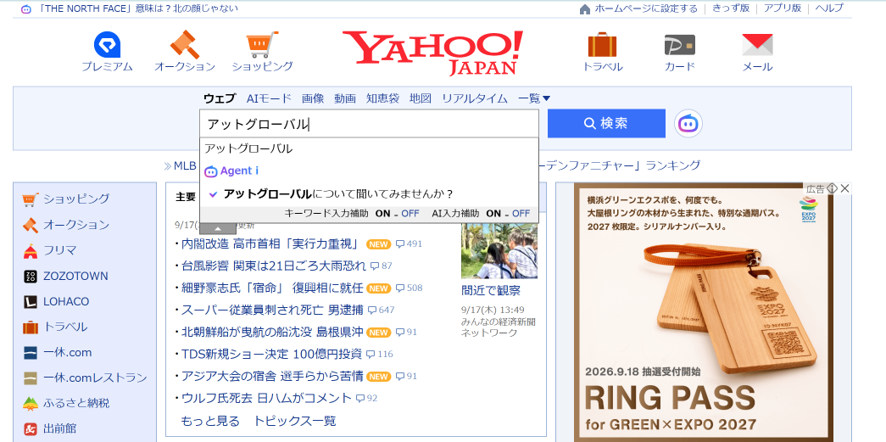
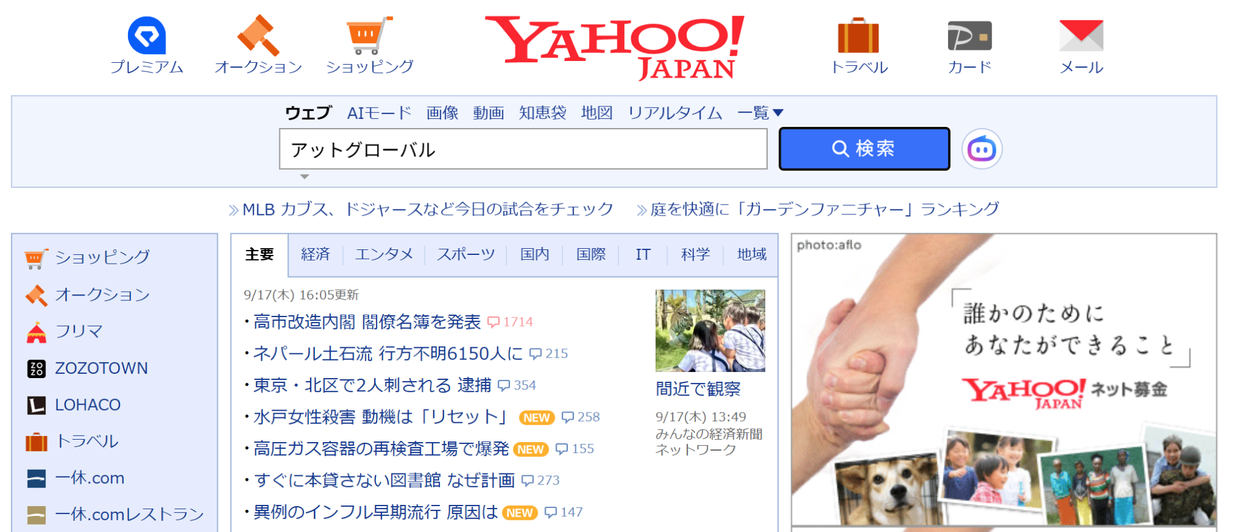
So where do people who do not use a VPN every day come across information about Japanese companies? The answer was Baidu, plus the in-app search inside WeChat, Xiaohongshu, Douyin and Taobao. If they visit a Japanese company’s website at all, it is either through a link inside one of these apps or by typing the URL directly.
In China, the problem is not that the site cannot be viewed. It is that Google and Yahoo!, the routes Japan relies on, do not lead there. A Japanese company can build its ads on the assumption that people will search and then visit the site, but that route does not exist in everyday life there.
The point where people abandon a form also said something about the market. The woman in her forties stopped when she was asked for her address. The man in his forties quit a car dealer’s survey halfway through because new pages of questions kept appearing without any indication of how many there were. On contacting companies, the woman said, “A messaging app feels more natural. Forms are a hassle, and I don’t want to reveal private information.” Before buying, the man checks other people’s ratings on the marketplace, especially what the low ratings say, compares prices across several marketplaces and, if there is no difference, buys from the official flagship store.
South Korea: All three generations open Coupang first
In South Korea, our staff member interviewed three women in their twenties, forties and fifties. On some questions, the answers matched regardless of age.
- Where people see ads: twenties, YouTube, Instagram and TikTok; forties, KakaoTalk, YouTube and NAVER; fifties, YouTube, NAVER and KakaoTalk
- First app opened to buy something: Coupang, for all three (a major Korean e-commerce marketplace)
- How people contact companies: chatbots. The woman in her fifties is used to forms too, but finds them inconvenient when there are many fields
The reasons they gave for choosing Coupang were “easy to search and compare,” “plenty of reviews” and “delivery the same day or the next.”
Where the ad led split between marketplaces and company sites. The woman in her twenties went from a cosmetics ad on TikTok to a product page on OLIVE YOUNG (a cosmetics and beauty retail chain). The woman in her forties went from a product ad shown when she searched on NAVER, and the woman in her fifties from a travel ad that played on YouTube, each to the advertiser’s own website.

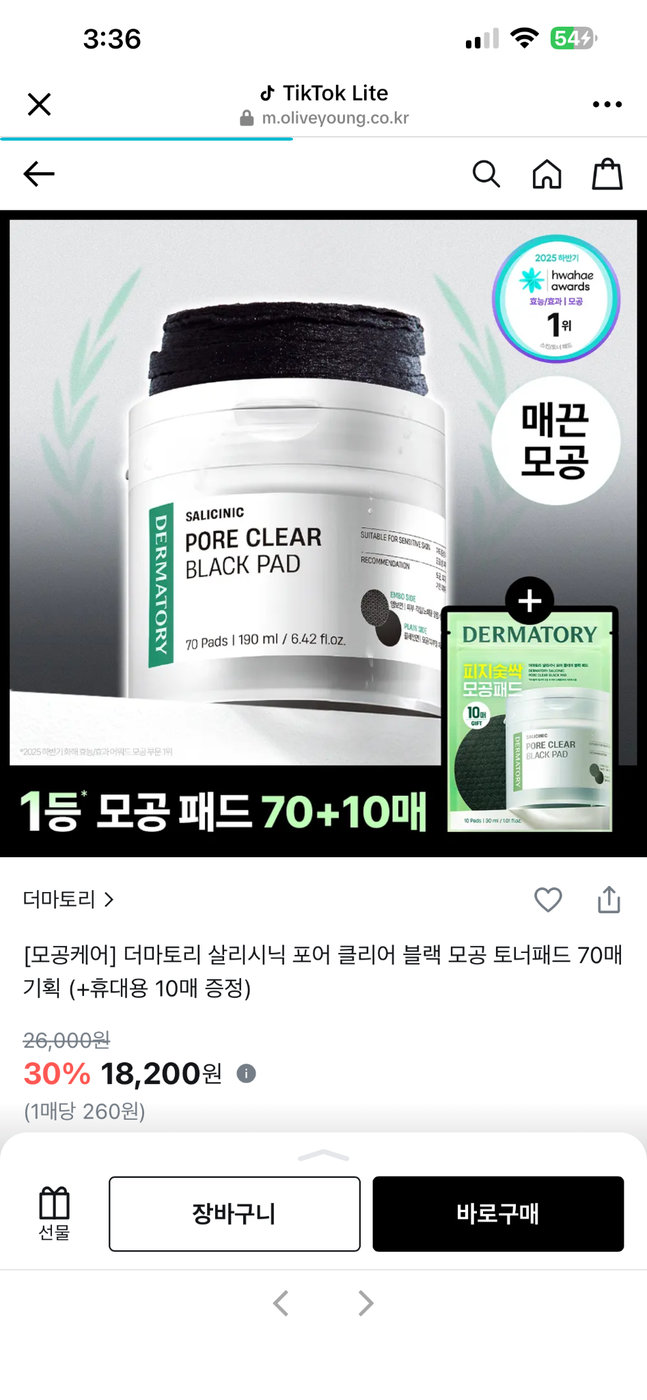
How they use search engines is also clearly divided. The woman in her twenties finds products and compares prices on NAVER (a major Korean search portal) and uses Google only to look up information or overseas sources. The women in their forties and fifties said they “hardly ever use” Google. Their default is looking for word-of-mouth on NAVER blogs and NAVER Cafe communities.
All three gave specific moments when they gave up on a form. For the women in their twenties and forties, it was the phone number.
“I’ve quit when asked to enter my phone number. A phone number is very likely to lead to ads and spam calls, so the risk is high.”
— Woman in her twenties, South Korea
The woman in her fifties stopped when asked for her full address.
The question we asked only in South Korea was about the consent screens on sign-up and inquiry forms. Korean forms often split consent into many separate required and optional items, and the screen our staff member photographed followed this format. All three said they check only the required items and leave the optional ones unchecked whenever possible.
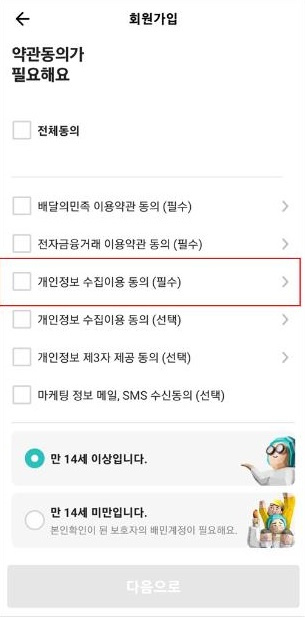
The woman in her twenties added this:
“I’ve never seen a Japanese website’s form, but if there’s only one checkbox, I can’t tell what information is being collected or how it will be used, so I don’t think I could trust it.”
— Woman in her twenties, South Korea
Japanese forms often use a single consent checkbox to keep the effort low. In South Korea, that simplicity becomes a source of anxiety instead.
On ads for Japanese brands, the woman in her twenties mentioned a short UNIQLO video she saw on Instagram and said it “gave a practical impression.” The women in their forties and fifties had “no memory of seeing one.” All three also said they had never seen a Japanese company’s website.
When we asked what to fix before advertising, the woman in her twenties said “localizing into the words and expressions people actually use in Korea,” and the woman in her forties said “the gap with prices in Japan.”
Vietnam: Inquiries go through chat, and a reply that takes 15 minutes is already slow
- Where people see ads: YouTube and Zalo (a messaging app widely used in Vietnam); young people also see them on TikTok
- First app opened to buy something: Lazada (a major Southeast Asian e-commerce marketplace; “the easiest to use and most trustworthy here”)
- How people contact companies: the in-app chat function
The last ad our respondent tapped was a YouTube ad for Learna AI, an English conversation app. Curious about a scene of people practicing English conversation with a robot teacher, they tapped it and landed on the app’s install screen.
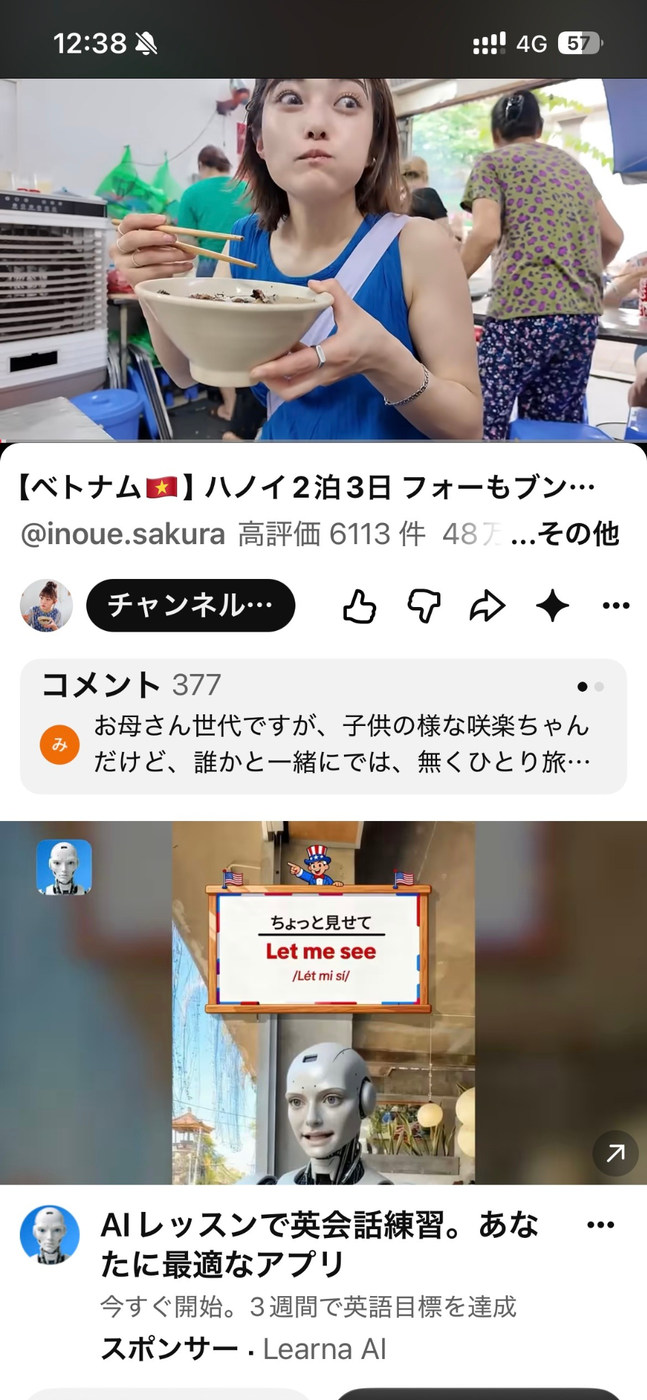
The question we asked only in Vietnam was about the process of contacting a business through the messaging app Zalo. The answer was very different from how Japanese companies think about handling inquiries.
“I don’t use Zalo as an e-commerce platform. I use it because Zalo is the usual way to contact sellers. The first thing I ask is whether the product actually exists and whether the price is as listed, because the information is often out of date and the item isn’t really available. With Zalo, if there’s no reply in 15 minutes, I feel it’s slow.”
— AtGlobal staff, Vietnam
Fifteen minutes. If your inquiry form promises a reply “within two to three business days,” the customer has moved on to another shop long before then. Sellers rarely ask for a phone number first, our respondent said, and they give one if asked.
The step that always comes before buying is checking reviews. Even when an ad catches their interest, they do not buy from the advertiser’s site. They look for the same product again on Shopee (a major marketplace alongside Lazada) or Lazada to check whether it is cheaper there.
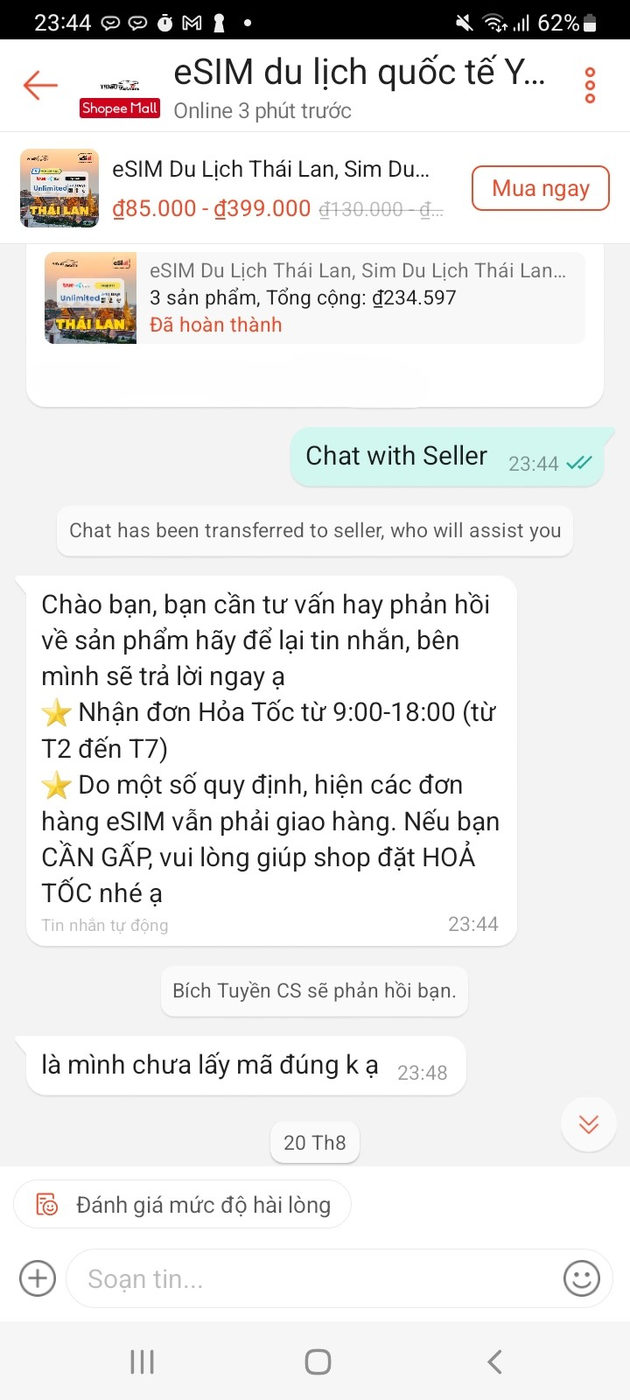
Our respondent has never abandoned a form halfway. They usually buy on Lazada, where individual shops never ask them to fill one in.
The habit of deciding on trust first showed up in the answer about consent text and cookie notices, too. If the company seems trustworthy, they tap without reading. If they are unsure, they stop there without reading. Either way, they do not read it. The decision is made before the consent text, by the question of whether the company can be trusted.
The Japanese brand ad they remembered was for Rohto eye drops, seen in a pharmacy. “I thought, so you can buy them in Vietnam, and at the same time I wondered whether the eye drops were the same quality as the ones sold in Japan.”
On what to fix before advertising, they said:
“There are so many counterfeit products around that you need something to show that you’re a trustworthy source.”
— AtGlobal staff, Vietnam
In our previous survey, too, our Vietnam staff member told us that “Vietnamese people doubt everything.” An ad can win attention, but without a way to prove the product is genuine, the customer finishes the purchase at another shop.
Thailand: The same LINE app, but a different style of message works
Our Thailand respondent currently lives outside Thailand, so they answered from their years of living there and from the LINE ads that still arrive from Thailand.
- Where people see ads: ads delivered on LINE, and ads in supermarket apps (Big C, Lotus’s, Tops)
- First app opened to buy something: Lazada, opened in a browser (“I think young people use the smartphone app”)
- How people contact companies: LINE and Facebook, or Lazada’s chat for brand-run stores on Lazada
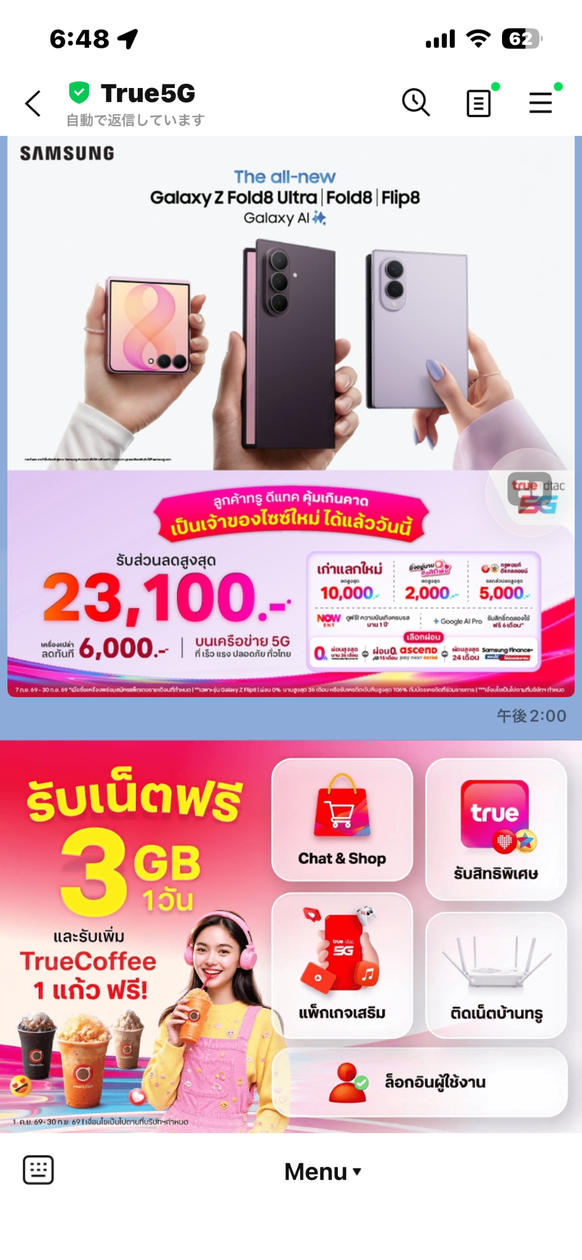
The way they shop on Lazada shows how they keep ads at arm’s length. Rather than entering through an ad, they compare the shops’ ratings (stars) and prices in the search results, and then go to that shop’s product page.
Before buying, they check reviews. In our previous survey, there was also an answer about asking friends for information.
They add companies as friends on LINE when they want to use a service or a points benefit. Large supermarkets and telecom companies send promotions every week, but they leave them as they are rather than blocking them.
Their resistance to filling in forms was on the low side compared with the other markets. “I’ll enter my name, phone number and address right away. I might think twice if I were asked for my ID, like a passport number.” The phone number and address that made people quit in South Korea and China are not barriers in Thailand.
What stood out in Thailand was a comment on style. When our respondent added some well-known Japanese companies as friends on LINE, they found the messages no worse than Thai companies’, but “if anything, a bit understated.”
“Thailand loves ads that make a strong impression and are funny, so in that sense they may be seen as boring. I think it would work to push the intensity of the creative in this direction: ‘you get it in an instant,’ ‘it moves you,’ ‘you want to tell someone,’ ‘you want to take a photo of it,’ ‘you want to post it on social media.'”
— AtGlobal staff, Thailand
The example they gave of a brand that gets it right was Calbee’s Kappa Ebisen shrimp snack. Its ads localize everything, from the colors, the characters and the humor to Thai celebrities and over-the-top expressions, and hold their own next to Thai products’ ads.

In 2024, Calbee even ran an ad that played on the fact that Thai people call Kappa Ebisen “Calbee.” A Japanese customer insists, “This is Ebisen,” and a Thai shop assistant refuses to budge: “It’s Calbee, isn’t it?” The ad turns the cultural gap itself into the joke, and our respondent described it as “a very Thai way of making an ad.”
When we asked what to fix before advertising, the answer was not a specific tweak but a change in thinking: from “good-quality Japanese products should sell” to “adapting to local culture is what matters.”
Taiwan: The same tools as Japan, but the translation breaks it
- Where people see ads: Instagram (twenties and thirties), Facebook (all ages), LINE (all ages; at the top of the chat list and in LINE TODAY’s news section)
- First app opened to buy something: Shopee Taiwan, to check typical prices and buyers’ reviews with photos
- How people contact companies: chat is “overwhelmingly natural”
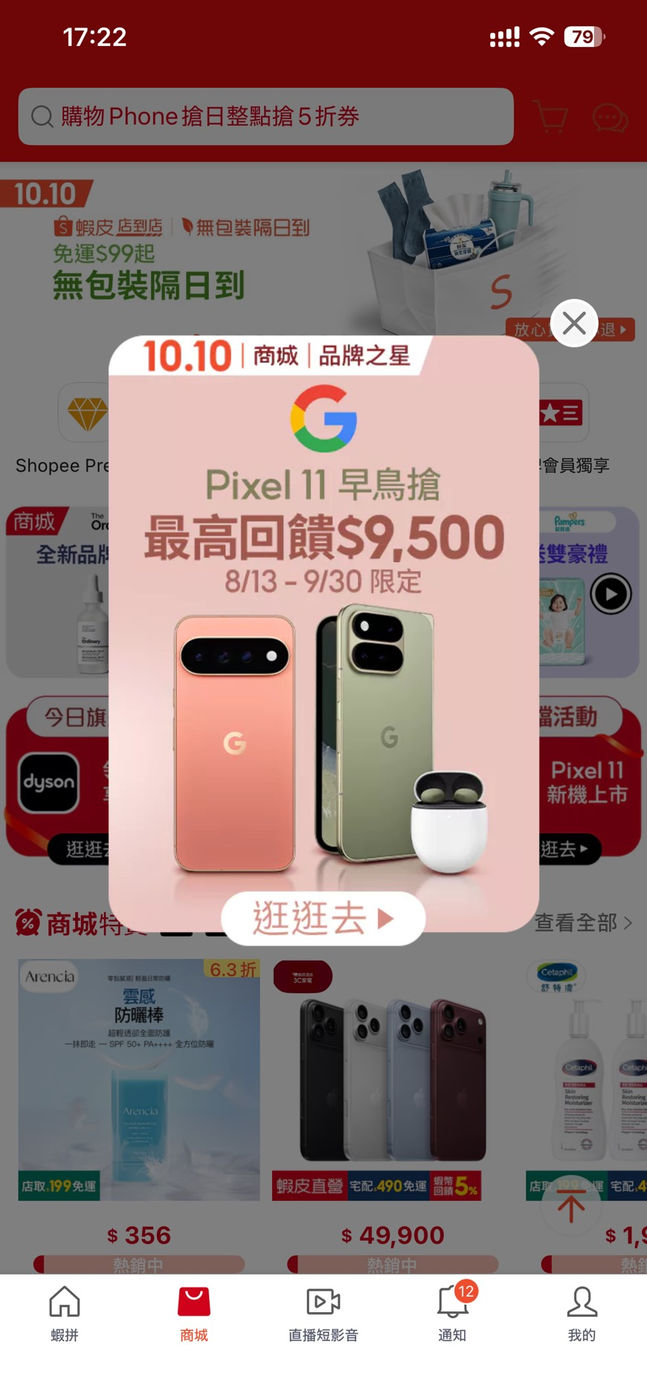
Taiwan’s everyday tools are the closest to Japan’s of the five markets. LINE is part of everyday life, covering everything from messages with family and friends to work and payments through LINE Pay. For search, Google is “the absolute default,” and our respondent has never seen anyone around them use Yahoo! Kimo, Yahoo!’s Taiwanese portal.
Even so, the way people contact companies differs from Japan. Web forms tend to be avoided, because “people in Taiwan don’t have the habit of checking email regularly.” People want the speed of a direct reply in chat, our respondent said. “Living here, I’ve started to feel the same way.”
When it comes to ads, wariness comes first. Our respondent never taps an ad on purpose; at most, they tap one by accident on a product page on Shopee or momo (a major Taiwanese marketplace) without realizing it is an ad. Before buying, they look for word-of-mouth on Dcard or PTT (major Taiwanese forums and community sites) and compare prices and reviews of similar items on Shopee. If they cannot find comments from actual buyers on Shopee, they hold off on buying. The aim is to rule out a scam site or a scam ad.
The same wariness applies to forms. Our respondent has not experienced this personally, but said they would probably quit if a sign-up form required an ID number or address from the very first step. People are so wary of fraud and data leaks that, without a clear reason such as customs clearance for an overseas shipment, many would find it suspicious and leave, our respondent believes.
This wariness of fraud showed up most sharply in the question we asked only in Taiwan, about translated text.
“You can tell it’s machine-translated when terms used in mainland China are mixed in. Expressions that reuse Japanese kanji words as they are, or honorifics translated literally into something unnaturally over-polite, are also noticed immediately. The moment they see this, I feel that many people suspect ‘this is probably a scam site’ and stop buying, before they even think ‘they’re not serious about the Taiwanese market.'”
— AtGlobal staff, Taiwan
Rough translation is read not as a company that does not care, but as a company that might be a scam. A language problem turns straight into a trust problem.
The Japanese brand ads our respondent sees most often are for cosmetics, such as Shiseido. The impression that “Japanese products are high quality” is strong, they said, but people also say it is hard to tell genuine products from daigou goods (items bought in Japan and shipped by purchasing agents) and parallel imports. As in Vietnam, the challenge is how to prove a product is genuine.
On what to fix before advertising, the answer was concrete:
“Before advertising, I think it’s about preparing the channels people in Taiwan use every day: a chat window such as a LINE Official Account, convenience-store pickup with payment on collection, and payment methods such as LINE Pay.”
— AtGlobal staff, Taiwan
The five markets side by side
We lined up the five markets’ answers in order, from seeing an ad to contacting a company.
| Market | First app opened to buy something | Where the ad led | How people contact companies | What makes people abandon a form | What people always check before buying |
|---|---|---|---|---|---|
| China | Taobao; the official store on JD.com for expensive items | An e-commerce product page (the man “doesn’t tap ads in the first place”) | Customer service at the marketplace’s official store, or a messaging app | Being asked for an address; pages that never seem to end | Low-rated reviews, and price comparisons across several marketplaces |
| South Korea | Coupang (all three generations) | A marketplace product page, or the advertiser’s own website | Chatbots | Being asked for a phone number or full address | Reviews, and price comparisons on another marketplace |
| Vietnam | Lazada | An app install screen | In-app chat, or Zalo (15 minutes feels slow) | No such experience | Reviews, and searching again on Shopee or Lazada |
| Thailand | Lazada (in a browser) | Not through the ad; from Lazada’s search results to the shop’s page | LINE, Facebook, or Lazada’s chat | Might hesitate at a passport number (name, phone and address are entered right away) | Reviews, and what friends say |
| Taiwan | Shopee Taiwan | A marketplace product page (never tapped on purpose) | Chat (forms tend to be avoided) | An ID number or address required at the start of sign-up | Word-of-mouth on Dcard or PTT, and reviews on Shopee |
In all five markets, the answer to “Have you ever closed a Japanese company’s website, thinking ‘this won’t work’?” was no.
What to fix before you spend more on ads
From the five markets’ answers, here are five things to review before adding to the ad budget. The order matters: before building out your own website, act on the places people actually go.
1. Put your landing point where people actually go
The ads led to marketplace product pages, app install screens and advertisers’ own websites. No one said they landed on a Japanese company’s website. In China, there is no route to a Japanese company’s site through Google or Yahoo!, and people get their information inside apps such as Xiaohongshu, WeChat and Taobao. In South Korea, Vietnam, Thailand and Taiwan, people compare on marketplaces and then buy. Rather than thinking only about pulling people to your own website, put an official presence where people actually complete their purchases.
2. Make chat your inquiry channel
In all five markets, chat was the natural way to contact a company. In Vietnam, a reply that takes 15 minutes feels slow, and in Taiwan, forms are avoided because people do not check email regularly. Open your inquiry channel on the chat each market uses, whether LINE, Zalo or the marketplace’s own chat, and design reply speed into it from the start.
3. Cut form fields based on each market’s reasons for quitting
Phone numbers (South Korea), addresses (China and South Korea), ID numbers (Taiwan), and input pages that never seem to end (China): the reasons people quit differ by market. At the same time, in Thailand, our respondent enters a name, phone number and address right away. Rather than cutting fields across the board, check whether the fields you treat as mandatory by Japanese standards are what make people leave in each market.
4. Show that you are genuine, and what people are agreeing to
In Vietnam and Taiwan, the central worry was not being able to tell genuine products from counterfeits or daigou goods. In South Korea, a form with a single consent checkbox comes across as “I can’t tell what I’m agreeing to.” Show proof that you are the authorized seller, and how personal information will be used, in a way that convinces readers in each market.
5. Make your translation and your creative speak the local language
In Taiwan, Traditional Chinese text mixed with mainland Chinese terms raises suspicions of fraud. In South Korea, the woman in her twenties also named localization into natural Korean as the first thing to fix. In Thailand, even an accurate translation gets ignored as a boring ad if the creative is too understated. Beyond replacing the words, adapt your creative and tone to what earns trust and gets talked about in each market.
Key takeaways
- None of the five markets had ever closed a Japanese company’s website in frustration. Not because people dislike Japanese companies, but because they never get that far
- The ads led to marketplace product pages, app install screens and advertisers’ own websites, never to a Japanese company’s website
- In China, there is no route to a Japanese company’s site through Google or Yahoo!
- In South Korea, all three generations start shopping on Coupang, and quit when asked for a phone number or full address
- In Vietnam, people contact companies by chat, and a reply that takes 15 minutes is too slow
- In Thailand, resistance to filling in forms is low, but Japanese companies’ ads come across as “understated”
- In Taiwan, translations mixed with mainland Chinese terms raise suspicions of a scam site
Some of what makes ads work lies outside the ad itself. Have you opened a channel where people go after they see your ad? All five markets’ answers led back to this question.
AtGlobal, Ltd. draws on staff living in 66 countries, who know their markets from the inside, to support translation, multilingual marketing and localization for overseas markets. If you want your ads and website to be accepted in a new market, contact us.
This article was edited by AtGlobal, Ltd. based on a written survey (13 questions plus screenshots) conducted from September to October 2026 with AtGlobal staff living in China, South Korea, Vietnam, Thailand and Taiwan. The answers reflect each respondent’s own experience and conversations with local colleagues, friends and family, and are not a statistical survey. Service and feature names are as of the time of the survey.