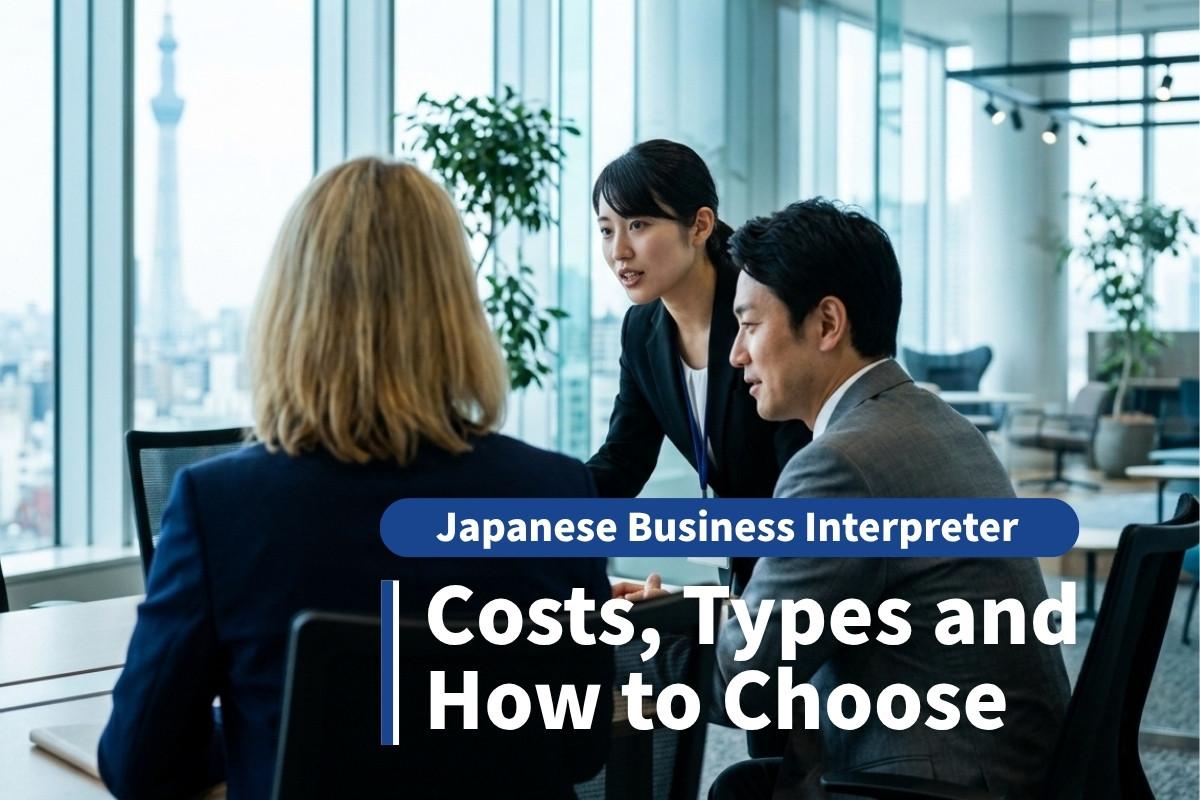
Japanese Business Interpreter: Costs, Types & How to Choose
Business Interpreting
Consecutive Interpretation
Interpretation Rates
Japan
Simultaneous Interpretation
Hiring a Japanese business interpreter is often the single highest-leverage investment a U.S. company can make before meetings in Japan. As of 2026, a professional consecutive interpreter typically costs ¥60,000 to ¥150,000 (roughly US$410 to $1,030) per day — a small line item compared with the value of the deals, audits, and partnerships those conversations decide.
And the language gap is real: Japan ranked 96th out of 123 countries in the 2025 EF English Proficiency Index, its lowest position ever, with spoken English lagging far behind reading comprehension.
This guide explains what a business interpreter in Japan actually does, when you need one, how consecutive and simultaneous interpretation differ, what rates to budget, and how to select and brief the right professional for your Japan market entry.
- What a Japanese business interpreter does beyond word-for-word conversion, and why cultural mediation protects your negotiation
- Realistic 2026 day rates for consecutive, simultaneous, whispered, and remote interpretation
- A decision framework for choosing the right interpretation type
- A five‑point checklist for selecting and briefing an interpreter
TOC
What a Japanese Business Interpreter Actually Does

A Japanese business interpreter enables accurate, real‑time communication between Japanese and English speakers during negotiations, meetings, and site visits. Beyond converting words, they bridge cultural context and intent — the layer where most business misunderstandings occur. In Japanese business settings, what is said and what is meant frequently diverge, and a skilled interpreter bridges both.
A quick definition for clarity: interpretation deals with spoken language in real time, while translation deals with written documents. A business interpreter specializes in commercial settings — negotiations, audits, executive meetings — as opposed to community, medical, or court interpreting.
The cultural layer is where professionals earn their fee. Japan is a high-context business culture: a polite “that would be difficult” (muzukashii desu ne) is usually a firm no, and silence often signals deliberation rather than agreement.
The distinction between stated positions (tatemae) and true intentions (honne) shapes every negotiation. An experienced interpreter recognizes these signals and conveys them to you, choosing the appropriate level of formality (keigo) so your message lands correctly with each rank in the room.
The role often extends beyond the meeting room, too. Many business interpreters in Japan also handle pre-meeting information gathering, meeting minutes, and follow-up correspondence with your Japanese counterparts — continuity that keeps momentum alive between visits, when most cross-border deals quietly stall.
When You Need a Japanese Business Interpreter
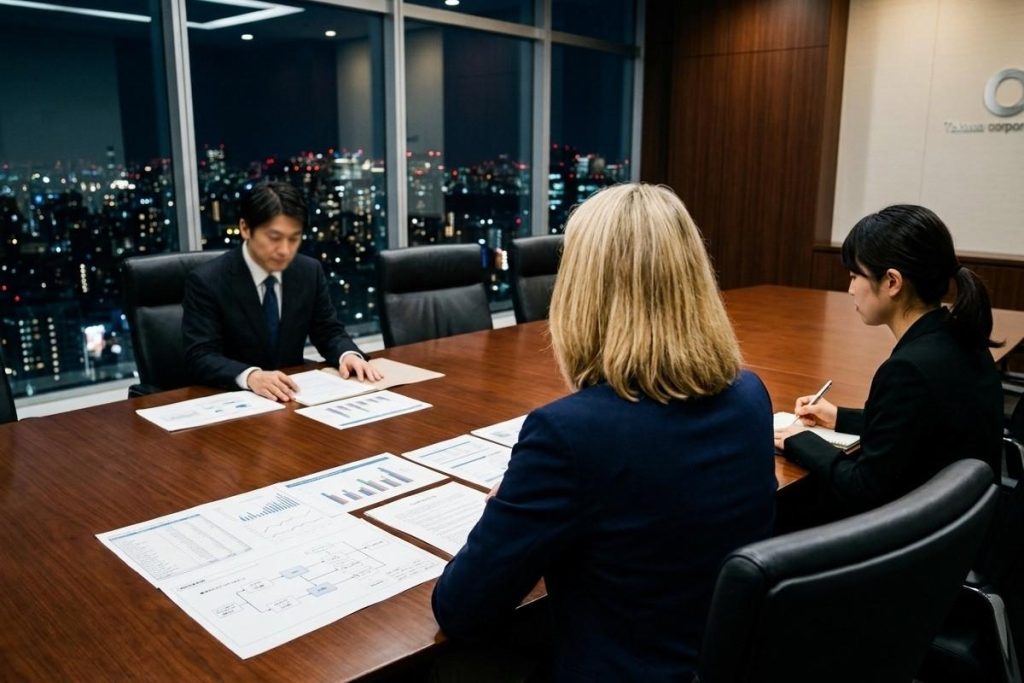
Plan on a professional interpreter for any meeting in Japan where the outcome affects revenue, compliance, or the relationship itself. According to the U.S. Commercial Service’s Japan Country Commercial Guide, Japan is one of the world’s largest economies and a top destination for U.S. business — but capturing that opportunity depends on communication that survives first contact.
Typical situations where U.S. IT companies engage interpreters:
- Distributor and partner negotiations: contract terms, pricing, and territory discussions where a single misunderstood clause is expensive
- Regulatory and government meetings: Japanese agencies operate in Japanese, and documentation requirements are precise
- Audits and due diligence: quality audits, security reviews, and M&A conversations demand technical accuracy
- Trade shows and exhibitions: events such as Japan IT Week, where booth conversations turn into pipeline
- Executive courtesy visits: first meetings with Japanese leadership follow protocol, and getting the greeting right sets the tone
- Post-deal implementation: kickoff meetings, user training, and support escalations with your new Japanese customers
One counterintuitive rule: bring an interpreter even when your counterparts speak English. Their team will still confer among themselves in Japanese during the meeting, and those side exchanges often contain the real signal — hesitations, objections, and internal disagreements. The internal consensus-building that actually decides outcomes — a process known as nemawashi — happens in Japanese, among stakeholders who may never attend your meetings, and your interpreter is your only reliable window into that layer.
Without an interpreter, you negotiate with an information asymmetry working against you: you hear only what is rendered for you, while the other side hears everything said in both languages.
Types of Business Interpretation in Japan

Consecutive interpretation is the right default for most business meetings in Japan; simultaneous interpretation is for conferences and large audiences, while whispered and remote formats cover specific gaps. Choosing correctly matters because the formats differ several-fold in cost.
Consecutive interpretation
The speaker talks for one to three minutes, then pauses while the interpreter renders the message. It roughly doubles meeting time, but it is the standard for negotiations, audits, and discussions of 2 to 12 people.
The built-in pauses are an underrated advantage in Japan: they give both sides time to think, which suits the deliberate pace of Japanese decision-making.
Simultaneous interpretation
The interpreter speaks almost concurrently with the speaker, typically from a booth with headsets for the audience. Because of the cognitive load, simultaneous work requires a team of two interpreters rotating every 20 to 30 minutes, per AIIC professional standards.
It preserves the meeting’s natural pace and is the right choice for conferences, town halls, and events with 15 or more participants — at a substantially higher price.
Whispered interpretation (chuchotage)
The interpreter sits beside one or two listeners and whispers a simultaneous rendering. It works well when, say, a U.S. executive joins a board meeting conducted in Japanese and is the only person who needs support.
Remote interpretation
Interpretation delivered over Zoom, Teams, or a dedicated platform. Since 2020 it has become a mainstream option for recurring calls with Japanese partners, early-stage discussions, and follow-ups — eliminating travel costs and shortening booking lead times. Note that per-hour rates are not automatically lower than on-site work — most providers set a two-hour minimum, and the real saving comes from travel and scheduling rather than the rate itself.
| Type | Best for | Typical group size | Meeting time impact | Relative cost |
|---|---|---|---|---|
| Consecutive | Negotiations, audits, business meetings | 2–12 people | Roughly doubles | Baseline |
| Simultaneous | Conferences, town halls, seminars | 15+ people | None | 4–7x (team of 2 + equipment) |
| Whispered | One or two listeners in a Japanese-language meeting | 1–2 listeners | Minimal | 1–1.5x |
| Remote | Recurring calls, early discussions, follow-ups | Any | Depends on mode | Similar per hour on-site; lower for short sessions, no travel costs |
When in doubt, decide on three variables: group size, formality, and pace. A negotiation with eight people, high formality, and room for pauses points to consecutive; an investor briefing for forty people on a fixed agenda points to simultaneous.
Many companies also mix formats across a Japan trip — simultaneous for the seminar, consecutive for the private meetings that follow it.
Japanese Business Interpreter Costs in 2026
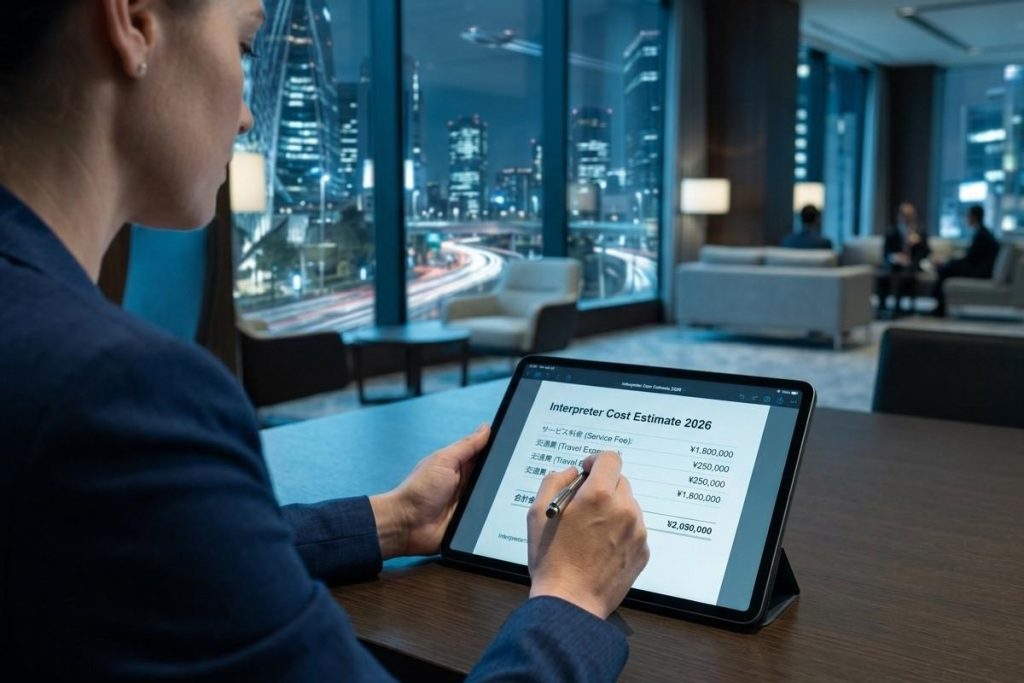
For a full-day consecutive engagement, most 2026 rate cards from Japanese agencies fall between ¥60,000 and ¥150,000 (roughly US$410 to $1,030), with elite specialists and simultaneous teams costing several times more. Rates cluster into tiers based on the interpreter’s experience and subject-matter depth.
| Engagement type | Typical full-day rate (JPY) | Approx. USD |
|---|---|---|
| General business consecutive (standard tier) | ¥60,000–¥90,000 | $410–$620 |
| Senior consecutive, specialized fields (IT, legal, finance) | ¥120,000–¥160,000 | $830–$1,100 |
| High-stakes technical or legal, agency-managed with preparation | ¥150,000–¥380,000 | $1,030–$2,620 |
| Simultaneous, team of two (per day) | ¥520,000–¥900,000+ | $3,590–$6,210+ |
USD figures are reference conversions at ¥145 = US$1 and will fluctuate with exchange rates.
Example: A Typical Japanese Agency Rate Card
For a concrete reference point, here is what AtGlobal, Ltd. publishes for Japanese-English business interpreting, by interpreter tier. Rates are quoted as starting prices, and a full day covers eight hours plus a one-hour break.
| Interpreter tier | On-site, half day (up to 4h) | On-site, full day (8h) | Whispered, full day |
|---|---|---|---|
| S — conference and executive level | from ¥95,000 ($660) | from ¥150,000 ($1,030) | from ¥160,000 ($1,100) |
| A — senior business and technical | from ¥75,000 ($520) | from ¥120,000 ($830) | from ¥130,000 ($900) |
| B — general business | from ¥55,000 ($380) | from ¥90,000 ($620) | from ¥100,000 ($690) |
| C — straightforward meetings, escort work | from ¥35,000 ($240) | from ¥60,000 ($410) | from ¥70,000 ($480) |
Online sessions are booked separately, from ¥40,000 for a two-hour minimum at general business level and from ¥90,000 at top tier. Overseas attendance runs from ¥85,000 to ¥135,000 per day plus travel. All figures are starting prices, before the surcharges listed below.
Beyond the day rate, plan for these common additions:
- Equipment for simultaneous work: booths, transmitters, and headsets add ¥150,000 to ¥450,000 per day
- Half-day rates: roughly 60 percent of the full-day fee, for engagements up to four hours
- Specialized subject matter: medical, legal, and financial content typically adds 20 to 30 percent to the base rate — a surcharge that applies to most enterprise IT and security engagements
- Rush booking: requests inside three business days commonly carry a surcharge of around 20 percent
- Early or late hours: work that runs before 8:00 a.m. or past 10:00 p.m. adds about 25 percent
- Travel and per diem: transportation is billed at cost; per diem ranges from about ¥5,000 to ¥25,000 per day depending on who covers lodging and meals
- Cancellation charges: commonly 30 percent from seven to four business days out, 50 percent at three to two days, and 100 percent the day before or the day of
Three factors drive where a quote lands within these ranges: the interpreter’s experience tier, the density of the subject matter, and how much preparation the engagement requires. When comparing quotes, ask specifically what is included — some agencies bundle preparation and coordination into the day rate, while others itemize each line.
Note also that several agency rate cards rose in 2025 and 2026 on the back of strong demand around Expo 2025 Osaka, so quotes from even a year ago may be outdated.
For budgeting the written side of your Japan launch — contracts, product UI, marketing content — see our 2026 guide to English-to-Japanese translation rates.
Choosing the Right Japanese Business Interpreter
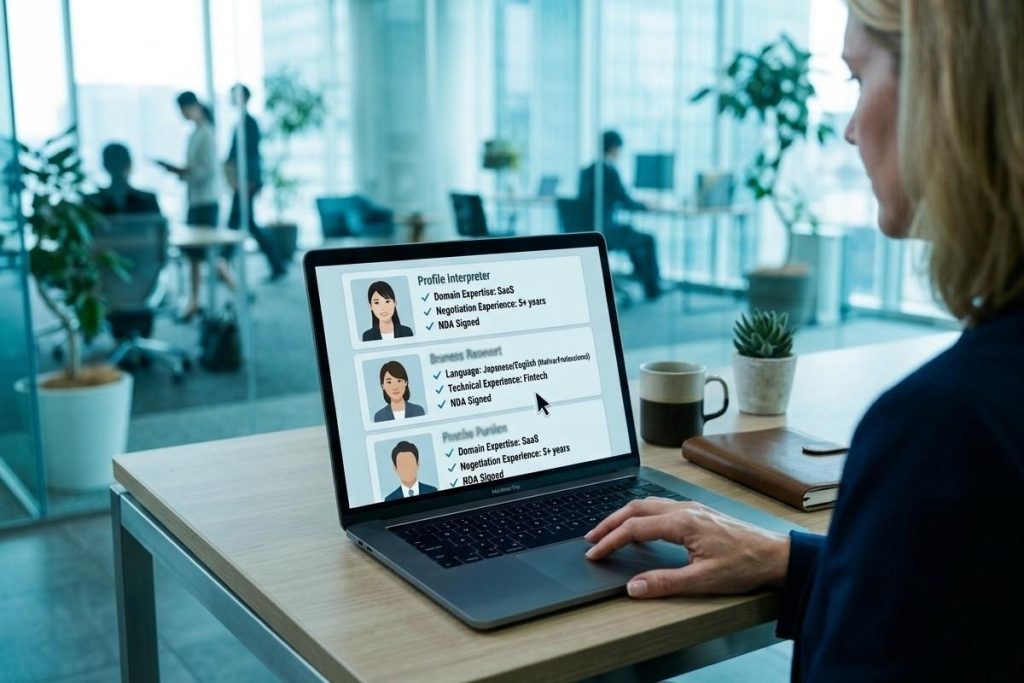
Match the interpreter to the stakes and the subject matter of your meeting — the difference between an adequate interpreter and the right one usually shows up in the details you cannot hear yourself.
Five selection criteria
- Domain expertise: an interpreter who knows SaaS, cloud, and security vocabulary in both languages will not stumble on your product architecture mid-negotiation
- Negotiation experience: escort or tour interpreting is a different skill; ask specifically about boardroom and contract-discussion experience
- Cultural fluency: the interpreter should read hierarchy and indirect signals, and be willing to advise you on them — not just relay words
- Confidentiality: a professional will sign your NDA without hesitation, and established agencies back this with their own confidentiality frameworks
- Logistics fit: confirm coverage for your meeting locations, remote capability, overtime terms, and availability across a multi-day schedule
You should also watch for red flags. An interpreter who accepts a technical negotiation without asking about your materials, glossary, or meeting goals is planning to improvise.
Rates far below the market ranges above usually mean tour-guide experience being sold as business interpreting. And if you cannot get a clear answer on who the actual interpreter will be — as opposed to the salesperson quoting you — keep looking.
For a first engagement, a short remote assignment is an inexpensive way to evaluate someone before trusting them with a boardroom.
Briefing Your Interpreter Before the Meeting
Send your materials at least one week in advance — slide decks, a glossary of product and technical terms, and the attendee list with names and titles.
Then hold a short call to align on your goals for the meeting, your red lines, and the mechanics: how long you will speak between pauses, whether the interpreter may interrupt for clarification, and who takes notes.
After the meeting, debrief. Experienced interpreters routinely catch signals — a change in tone, a deflected question, a junior employee’s glance — that determine what your follow-up should say.
Language Support Beyond Interpretation for Japan Market Entry

An interpreter solves the meeting itself, but entering Japan requires a broader language and cultural infrastructure. The same weeks that hold your negotiations also generate contracts to translate, marketing content to localize, and internal teams who need to understand how their Japanese counterparts work.
The Japan-based language services company AtGlobal supports overseas companies through exactly this sequence: business interpreting in consecutive, simultaneous, whispered, and remote formats, document and marketing translation across 50+ languages, and cross-cultural (CQ) training that prepares your team for Japanese business communication before the stakes get high.
Across the interpreter assignments that AtGlobal has handled for overseas clients — from trade-show booths to distributor negotiations — a consistent pattern stands out: the meetings that succeed are the ones where the interpreter was briefed early and treated as part of the deal team, not hired as a commodity the day before.
Public-sector support is worth combining with private help: JETRO’s Invest Japan program offers foreign companies free consultation and temporary office space when establishing a Japanese entity.
Frequently Asked Questions About Japanese Business Interpreters
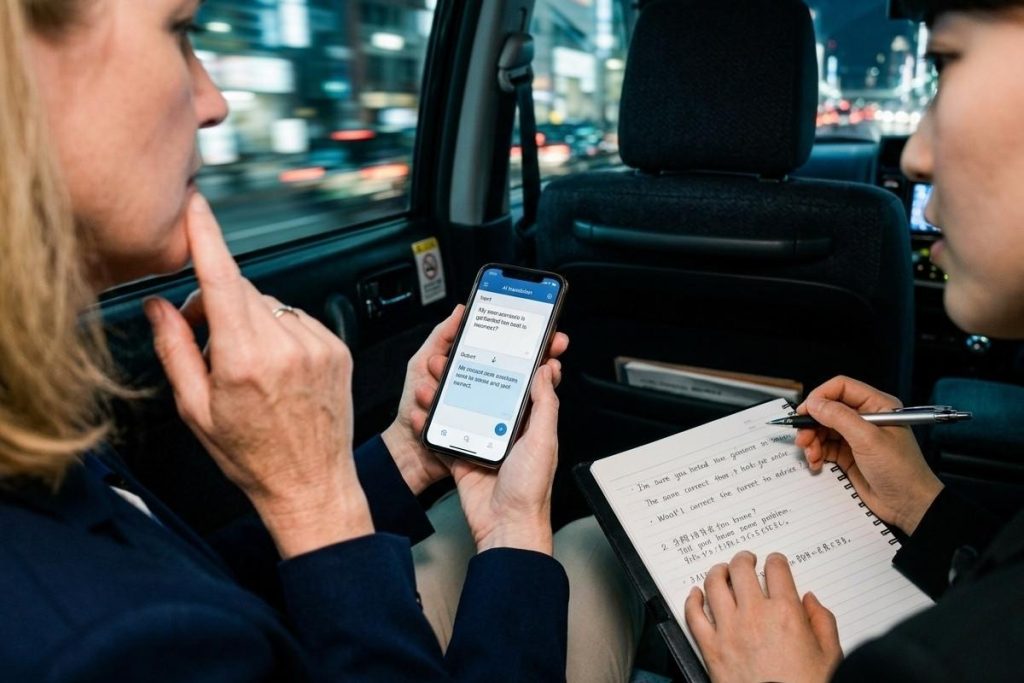
- Can we rely on AI translation apps instead of a human interpreter?
-
For logistics — taxis, restaurants, casual conversations — yes, and translation apps have improved dramatically. For negotiations, audits, and regulatory meetings, no.
AI tools translate words but often miss intent: they may render a polite Japanese deferral as literal hesitation, miss honorific signals about hierarchy, and offer no judgment about what should be said differently. They also introduce confidentiality risk, since spoken input may be processed on external servers. Use apps for travel; use a professional for anything with commercial or legal consequences.
- Should we book through an agency or hire a freelance interpreter?
-
Agencies cost more but reduce risk: they match interpreters to your industry, provide vetted backups if someone falls ill, handle equipment for simultaneous work, and take contractual responsibility for confidentiality and quality.
A trusted freelancer can be excellent value for recurring, lower-stakes engagements once you know their work. For a first high-stakes meeting in Japan — where you cannot yet evaluate an interpreter’s performance yourself — agency accountability is usually worth the premium.
- How far in advance should we book a Japanese business interpreter?
-
Book two to four weeks ahead for standard business meetings, and six to eight weeks for simultaneous interpretation, specialized technical subjects, or peak periods.
Top-tier interpreters in fields like IT and finance are scheduled well in advance, and demand has tightened since Expo 2025. Last-minute bookings mean choosing from whoever is available rather than whoever is right — and they eliminate the preparation time that makes interpretation accurate. Booking inside three business days also typically triggers a rush surcharge of around 20 percent.
- Will an interpreter sign an NDA before confidential negotiations?
-
Yes — treat this as standard practice, and be wary of anyone who resists. Professional interpreters work under strict confidentiality norms, and established agencies operate their own information-security frameworks covering staff and contractors alike.
For M&A discussions, unreleased product roadmaps, or security audits, sign the NDA before sharing briefing materials, and confirm how documents will be stored and destroyed after the engagement.
- Is it rude to bring our own interpreter to a Japanese company’s office?
-
Not at all — it is read as a sign of seriousness. Japanese executives regularly bring interpreters to international meetings themselves, and arriving with a professional shows you invested in communicating accurately rather than forcing your hosts to struggle in English.
Mention in advance that your interpreter will attend, so seating and introductions can be arranged. The gesture of respect matters more than perfect execution.
Key Takeaways About Japanese Business Interpreters
- A Japanese business interpreter mediates culture and context, not just vocabulary — the honne behind the tatemae is where deals are decided
- Japan’s spoken-English gap is real and widening: 96th of 123 countries in the 2025 EF EPI, with speaking its weakest skill
- Consecutive interpretation is the default for negotiations and meetings of 2–12 people; simultaneous suits conferences of 15+
- Budget ¥60,000–¥150,000 (about US$410–$1,030) per day for consecutive work in 2026, and add 20 to 30 percent for specialized technical subject matter
- Bring an interpreter even when your counterparts speak English — their internal exchanges in Japanese carry the real signal
- Select for domain expertise, negotiation experience, cultural fluency, confidentiality, and logistics fit
- Brief your interpreter a week ahead with materials and goals, and debrief afterward for the signals you missed
- Interpretation works best as part of a full market-entry language stack — interpreting, translation, and CQ training — the combination that AtGlobal provides from Japan