Why Your Japanese Marketing Translation Quietly Fails
Japanese marketing translation is the layer where a foreign company’s Japan investment either converts into revenue — or quietly fails to land.
If you are a Localization Manager evaluating vendors, briefing translators, or trying to explain to your CMO why your last Japanese campaign underperformed, this guide is designed to give you a single, practical reference.
We will walk through what “marketing translation” really means in the Japanese context, why so many Western campaigns fail when translated literally, and how AtGlobal’s CQ Translation methodology produces Japanese copy that performs rather than copy that merely mirrors the English source. By the end, you should be able to brief, evaluate, and measure Japanese marketing translation with the same rigor you apply to your home-market creative work. (※CQ Translation is a registered trademark of AtGlobal in Japan.)
For the broader context of how marketing translation fits into a full Japan market entry, see our pillar guide on how to enter the Japanese market. This article assumes you have already decided to invest in Japan and are focused specifically on getting the marketing translation layer right — the layer that, for foreign companies serious about Japan, often determines whether the rest of the investment converts.
This article covers the following topics:
- Causes of literal translation failure and the value of CQ Translation
- Distinctions and use cases for translation, localization, and transcreation
- Best practices for vendor selection, creative briefs, and quality assurance
- Pre-translation Japanese SEO research and ROI measurement frameworks
TOC
What “Japanese Marketing Translation” Actually Means

Marketing translation as its own discipline, not a sub-category of translation
The most common mistake foreign companies make when sourcing Japanese marketing translation is treating it as a procurement line under “translation services.”
It is not.
Marketing translation in Japan is a distinct creative discipline that overlaps with copywriting more than with linguistic conversion. Its purpose is not to render meaning accurately from English into Japanese; its purpose is to make a Japanese reader feel, decide, and act.
That goal — driving an action in the target audience — places marketing translation closer to advertising creative than to document translation, and the skills, workflow, and pricing should be calibrated accordingly.
Marketing translation handles every customer-facing surface where persuasion matters:
- Brand storytelling and positioning
- Ad headlines and campaign copy
- Landing-page copy and CTAs
- Email campaigns and nurture sequences
- Case studies and white papers
- Video scripts and voiceover
- Social posts and product descriptions
- Sales decks and pitch materials
Each of these surfaces has its own tone, length, register, and conversion goal. A skilled marketing translator working in Japanese reads the source as a creative brief, not as text to be rendered, and produces Japanese copy that achieves the same emotional and commercial outcome the original was designed to achieve.
The three layers — translation, localization, transcreation
Three terms get used interchangeably across most vendor websites, but they describe distinct disciplines that any Localization Manager working in Japan must hold separately:
- Translation — the rendering of source-language meaning into target-language equivalents. Accurate, fluent, but anchored to the original sentence structure.
- Localization — the broader adaptation of content to fit the cultural and operational norms of the target market: units, dates, regulatory disclosures, image choices, color associations, address conventions.
- Transcreation — the most creative layer: the reimagining of content so that it evokes the same emotion and intent in the target language, even when this requires departing significantly from the source words.
For Japan, the order of work for marketing content is not “translate, then localize, then transcreate.” It is closer to the reverse: decide what should emotionally land for a Japanese reader, transcreate to that target, localize the surrounding context, and translate only the parts that are genuinely informational.
Why Japanese is uniquely demanding for marketing translation
Three features of the Japanese market — cultural, relational, and structural — make marketing translation harder than linguistic conversion, and none can be solved by fluency alone:
- High-context communication — in Japanese, much of the meaning is implied rather than stated, and over-explicit copy reads as condescending or foreign.
- Trust is earned through evidence, not self-assertion — Western copy builds credibility by claiming it (“revolutionary,” “#1”); Japanese buyers trust track record, third-party proof, and reputation. Self-promotion reads as a credibility risk, so the persuasive mechanism itself must be rebuilt.
- A consensus-driven buying process — Japanese B2B decisions move through collective internal alignment, not an individual champion. Copy has to support a longer, group-based trust-building sequence, so the direct “act now” framing that drives Western conversion has no one to act on it.
A line like “Our revolutionary, industry-leading platform delivers an unparalleled, seamless experience that empowers your team to transform the way you work” can be translated flawlessly and still fall flat: every phrase that signals confidence in English signals exaggeration in Japanese, and none of it offers the evidence a Japanese reader needs to trust it. The failure is not in the words but in the commercial logic beneath them — which is why marketing translation for Japan is a creative-cultural discipline, not a linguistic one.
Why Western Marketing Translation Fails in Japan

The “linguistically correct, commercially dead” problem
The single most common failure mode we see in Japanese marketing translation is copy that reads as technically accurate to anyone who checks word-by-word, but registers as foreign, awkward, or untrustworthy to actual Japanese readers.
The translator did their job in the narrow linguistic sense. The Japanese audience did not respond. The pipeline did not move. The brand was perceived as a foreign import that had not really arrived.
This pattern is so prevalent that it has its own diagnostic shape:
- Conversion rates on Japanese landing pages lag well behind their English-language equivalents, despite comparable traffic quality and product fit
- Email open rates underperform regional benchmarks
- Sales-development reps notice that Japanese leads convert at a fraction of US rates despite similar product fit
- Customer success teams hear feedback like “the copy felt translated” — the most common direct signal that the marketing translation has failed
Cultural defaults that break Western marketing copy
Japanese marketing audiences operate with cultural defaults that quietly invalidate large parts of the Western marketing toolkit:
- Confident self-promotion, common in US copy, reads in Japan as a credibility red flag rather than a strength
- Direct calls to action (“Buy now,” “Sign up today”) trigger discomfort rather than urgency in B2B audiences
- Individual-empowerment themes (“Be your best self,” “Take control”) that fuel resonance in American campaigns fall flat in a culture that values belonging, trust, diligence, and effort
Western marketing also relies heavily on superlatives, exclusive claims, and time-pressure mechanisms — all of which are dampened or modified in Japanese marketing conventions.
A US headline that says “The world’s #1 platform” lands as bragging in Japan; the same idea phrased as quiet authority backed by evidence lands as credible.
None of this can be detected by linguistic translation. It can only be addressed by a translator who works culturally before linguistically.
Real-world cautionary tales — separating myth from the failures that actually matter
The history of Western marketing in Japan is full of cautionary tales — but the most famous ones are often misremembered, and the failures that actually cost money are quieter:
- The often-cited Pepsi “Come Alive” mistranslation story should not be used as a Japan-specific example. The claim is widely repeated in marketing lore, but public verification is weak, and the story is usually associated with China rather than Japan.
- Toyota launched the Lexus channel in Japan in August 2005 with a dedicated dealer network and a strong emphasis on hospitality and premium service. If you want to discuss why foreign luxury branding can be challenging in Japan, that interpretation should be presented as analysis rather than as a documented Toyota-stated cause.
- IKEA began its early Japan-market effort in the 1970s, with IKEA Corners opening in 1974, its first store opening in 1977, and the initial effort ending in 1986. It returned in 2006 after extensive market preparation and adaptation.
More recently, the era of cheap machine translation has produced a quieter but more pervasive set of failures: brand websites in Japanese that read as machine-rendered, ad campaigns that crash on launch because the Japanese copy is technically accurate but tonally wrong, and B2B sales decks that erode credibility on first read.
These failures rarely produce headlines. They produce missed pipeline, quiet churn, and country managers who cannot understand why the brand is not landing.
A typical example we encounter on diagnostic engagements: a US-based B2B SaaS company invests heavily in Japanese-language paid search to drive demos, only to find that engagement on the Japanese landing page was significantly weaker than expected.
Diagnosis reveals that the headline, while linguistically accurate, uses a tone of voice that reads as aggressive American marketing to Japanese IT decision-makers, while the call-to-action (“Try free for 14 days”) triggers caution rather than action because Japanese B2B buyers expect a different sequence of trust-building before any trial.
None of these issues are visible in linguistic QA; all of them are visible to a CQ-trained reader on first read.
Introducing CQ Translation — AtGlobal’s Marketing Translation Methodology

What CQ Translation is, and why it differs from standard transcreation
CQ Translation is AtGlobal’s term for marketing translation executed with Cultural Intelligence Quotient (CQ) as the operating system rather than as a stylistic finish.
Standard transcreation, as practiced across the industry, focuses on re-rendering creative copy with cultural sensitivity. CQ Translation goes further: it treats every piece of marketing content as a cultural artifact whose purpose is to produce a specific emotional and commercial response in a Japanese reader, and it begins the work from that reader’s state of mind rather than from the English source.
The English brief is treated as one input, not as the master.
The practical implication is that CQ Translation cannot be performed by a translator who is only bilingual. It requires a translator who is:
- Culturally fluent in both source and target markets
- Experienced inside or alongside Japanese marketing organizations
- Able to read a Japanese buyer’s reaction the way a native marketing copywriter reads a domestic audience
AtGlobal’s marketing translation teams are built around this profile.
The Japanese-Reader-First principle
The defining principle of CQ Translation is that the Japanese reader, not the English source text, is the starting point.
Before a single sentence is drafted, the translator asks:
- Who is this reader?
- What emotional state will they be in when they encounter this content?
- What cultural expectations do they hold about how a brand should communicate at this stage of their journey?
- What does success look like — a click, an inquiry, a sign-up, a forwarded link, a memorable impression?
Only after those questions have answers does the translator return to the English source, treating it as a creative brief rather than a script.
The English copy supplies intent, claims, and structure; the Japanese rendering supplies language, register, rhythm, and cultural resonance.
This sequence — reader first, then source — is what separates CQ Translation from translation-as-procurement.
The three questions every CQ Translator asks
In practice, every CQ Translator working at AtGlobal trains to ask three questions before producing Japanese copy:
- What emotional state will receive this message? — curiosity, skepticism, urgency, trust, fatigue, hope?
- What category vocabulary does this audience already use? — what are the actual Japanese terms searched, listened for, and written internally to justify a purchase, and where do they diverge from English category labels?
- What level of politeness, formality, and register fits this channel and this stage of the buyer journey? — a cold landing page is not the same register as a fifth-touch sales email, and the difference matters in Japanese far more than in English.
These three questions, applied to every output, are how CQ Translation produces copy that resonates with Japanese readers rather than copy that mirrors English structure.
How CQ Translation produces copy that performs, not copy that mirrors
The outcome of this methodology is Japanese marketing copy that tends to outperform literal translation on the metrics Localization Managers care about — click-through, time on page, lead quality, conversion, and brand-recall in user research — though the size of the gain varies by audience, channel, and offer.
The copy reads as native because it was written for a Japanese reader from the start, with the English source serving as the strategic brief rather than the linguistic master.
A concrete illustration: An English headline such as “Stop wasting time on manual reporting — automate it in minutes” might be translated literally as:
「手動レポート作成に時間を無駄にするのをやめましょう。数分で自動化できます」
The translation is linguistically correct and commercially weak in Japan — the imperative phrasing (“stop wasting time”) feels confrontational, and the time-promise feels exaggerated to Japanese B2B audiences.
A CQ Translation might render the same intent as:
「レポート作成にかかる時間を、見直してみませんか。数分で自動化を実現できます」
(Why not take another look at the time your reporting takes? You can automate it in just minutes.)
Softer, invitational, evidence-anchored, with the same commercial message but delivered in a register Japanese decision-makers actually respond to.
The difference is not only linguistic but also cultural, and in practice it can show up in engagement and conversion outcomes.
This is the standard long-term enterprise clients expect from a marketing translation partner. CQ Translation is how AtGlobal meets it — formalizing the cultural and commercial judgment that marketing translation demands but most translation work has lacked, grounded in years of enterprise engagements that include Fortune Top 10 technology companies.
When to Use Translation, Localization, or Transcreation for Japan

A decision framework for Localization Managers
The most useful mental model for choosing between translation, localization, and transcreation is to ask: what is the primary purpose of this content, and what cost does failure carry?
- Pure translation is appropriate when the content is informational and the cost of cultural-fit failure is low — technical documentation, internal training materials, regulatory text where literal accuracy is mandatory.
- Localization is appropriate when the content is informational but cultural and operational fit affects usability — pricing pages, help center articles, onboarding flows, where Japanese readers need to feel the experience was built for them but the message itself is not persuasive.
- Transcreation is appropriate whenever the purpose of the content is to move a Japanese reader toward action, perception, or memory: ad headlines, landing pages, brand storytelling, video scripts, social copy, sales decks, case studies, press releases.
Worked example — one piece of content across all three layers
Consider a single B2B SaaS product page. Each section requires a different layer:
- Header value proposition (H1 and subhead) requires transcreation — its sole purpose is to make a Japanese decision-maker continue reading.
- Feature descriptions require localization — their purpose is informational but cultural framing affects clarity.
- Technical specifications table requires translation — accuracy is paramount and creative latitude would introduce risk.
- Customer testimonials require transcreation — the entire purpose is emotional credibility and a literal rendering of an American customer’s quote will read as foreign on a Japanese page.
A vendor who treats the entire page as a single translation job will under-invest in the surfaces that drive conversion and over-engineer the surfaces that do not need it.
A Localization Manager who briefs each section to the right layer extracts substantially more value from the same total budget.
Mistakes Localization Managers make in selecting the wrong layer
Two patterns recur:
- Over-translating — treating every page as if it requires transcreation, which inflates cost without commensurate revenue impact and exhausts limited creative-translation capacity.
- Under-investing (the more common mistake) — treating high-conversion surfaces (homepage hero, paid-ad landing pages, top-of-funnel email) as if they were technical translation, and missing the revenue lift that proper transcreation would have delivered.
A simple rule of thumb: count the number of words on a given page or asset, and ask what percentage of those words actually drive the conversion outcome. On many product pages, only a relatively small portion of the copy does most of the persuasive work — typically the headline, subhead, CTA, social proof, and a few key supporting lines.
Transcreate that high-impact minority intensively, localize the supporting informational content, and translate the rest where literal accuracy is all that matters.
What Localization Managers Should Brief, Specify, and Review
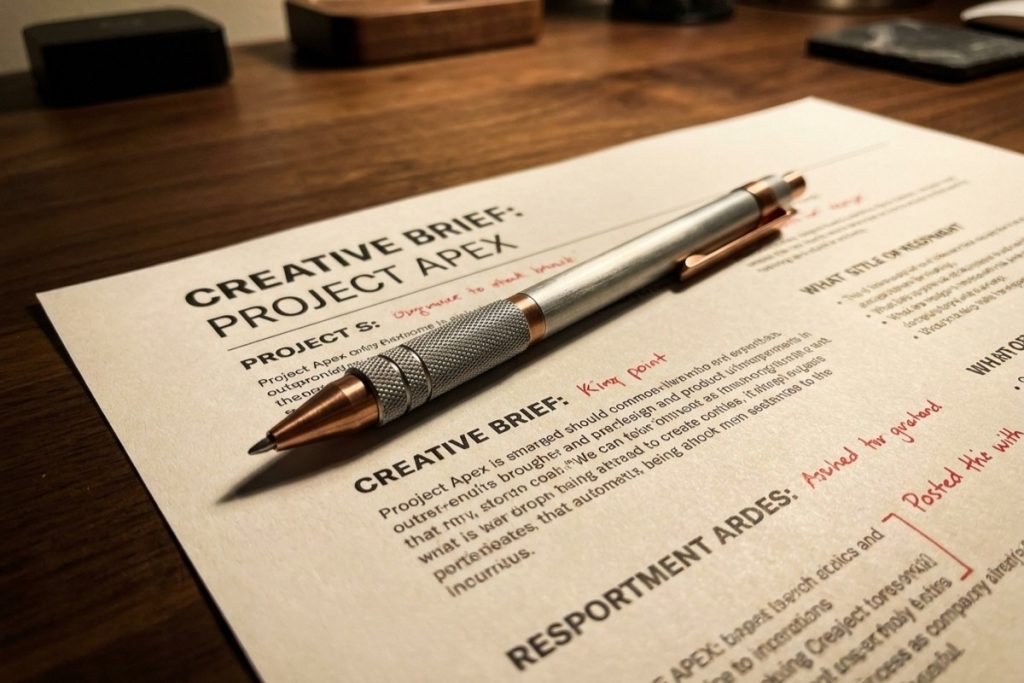
Anatomy of a strong marketing translation brief
A strong brief for Japanese marketing translation contains six elements:
- Business objective — what action you need the Japanese reader to take with this specific piece of content.
- Target audience profile in Japanese terms — not “B2B decision-makers” generically, but “IT department heads at Japanese enterprises evaluating cloud platforms in the consideration stage.”
- Brand voice and three to five voice adjectives that the brand has committed to.
- Key terminology — the Japanese terms you have already validated with native speakers as the correct category vocabulary.
- Channel context — where will this run, on what surface, at what point in the buyer journey.
- Success metrics — what will you measure to determine whether the translation worked.
A brief without these elements forces the translator to invent assumptions that may not match your strategy. A brief that contains them transforms the translator from a linguistic service provider into a strategic creative partner.
Reference materials that materially improve quality
The quality of transcreation outputs is materially improved when the translator has access to a small but well-chosen set of reference materials:
- The original English source in final approved form
- Two or three best-performing Japanese examples from your brand or competitors that exemplify the tone you want
- A one-page glossary of approved Japanese terms for your product and category
- A brand-voice document or style guide
- The URL or context where this content will appear
These references compress what would otherwise be days of back-and-forth into a single high-quality first draft.
Tone-of-voice and Japanese style-guide essentials
A Japanese marketing style guide does not need to be exhaustive, but it must answer a small number of high-leverage questions:
- Do we use です・ます (polite) or である (declarative) for marketing copy in this channel?
- How far do we allow self-praise and superlatives (“best,” “#1,” “revolutionary”), given that they read as exaggeration rather than confidence in Japanese?
- How do we build credibility instead — through evidence, track record, and third-party proof?
- What is the policy on katakana versus translated terms for English-origin concepts, especially category keywords?
- What is the policy on first-person plural (“we”) versus brand-name reference?
Answering these consistently produces output that feels like one brand voice across surfaces.
How to review Japanese marketing copy without speaking Japanese
Localization Managers who do not personally read Japanese are not powerless to review quality. Three techniques scale well:
- Ask the translator for a “back-translation summary” that explains, in English, the reasoning behind each major creative choice — not a literal back-translation, but an explanation of intent and effect.
- Route the Japanese copy through a native Japanese reviewer who is not the translator, ideally someone with marketing experience, for a quality and effect check.
- Maintain a small panel of three to five Japanese-native customers or employees who can react to candidate copy on a quarterly basis.
None of these substitutes for fluency, but together they create accountability and visibility — and they prevent the most common review failure, which is silent acceptance of work no one has actually evaluated.
Japanese SEO and AI Search Integration with Marketing Translation

Why Japanese keyword research must precede translation
A frequent mistake is treating Japanese SEO as something to be applied after the translation is complete. In reality, Japanese keyword research must precede translation, because the words your Japanese buyers actually search for in your category may not be the literal translations of your English keywords. The right sequence is:
- Map the English source keywords — list the core terms, claims, and category labels the original copy is built around.
- Research how Japanese buyers actually search — validate, with native speakers and search-volume data, the real Japanese terms your audience uses in this category, including katakana-versus-kanji variants and the colloquial phrasing they search and write internally.
- Brief the transcreation to those validated terms — hand the translator the confirmed Japanese keyword set as part of the creative brief, so the copy is written around the language buyers use rather than the literal rendering of the English.
Done in this order, keyword research shapes the copy from the first draft, rather than being retrofitted onto Japanese text that was never written to be found.
Keywords are only half of it — the rest is covered in our guide to Japanese website translation.
Google, Yahoo! Japan, and AI-driven discovery
Japanese discovery spans several surfaces, and the mix keeps shifting:
- Google leads, and because Yahoo! JAPAN draws on Google’s search results, the two have long accounted for the bulk of conventional search — though other engines have been gaining ground.
- Yahoo! JAPAN still matters as a distinct ecosystem of news, shopping, and Q&A, not just a search box.
- AI-driven search is the fastest-growing surface — ChatGPT, Perplexity, Gemini, and Claude — where Japanese executives and buying-committee members increasingly ask conversational questions in Japanese.
Google has said that poorly done machine translation can hurt rankings and recommends native-speaker review, while LLMs tend to favor original, in-depth content over thin or machine-rendered pages — exactly what transcreation produces.
How transcreation strengthens AI search visibility
Large language models, when asked Japanese-language questions, draw on the corpus of Japanese-language content they have ingested. A brand with only a thin or machine-rendered Japanese presence gives these models little quality material to surface, making it less likely to be represented well in Japanese-language AI answers — a tendency consistent with the well-documented English bias of LLM training data.
Native keyword research reveals that Japanese B2B buyers also search frequently for:
- 「MA ツール」 (MA tool) — often the primary entry point
- 「マーケティング自動化」 (marketing automation, written with kanji rather than katakana) — used by segments that signal more technical authority
Relying only on the katakana spelling misses a meaningful share of the addressable search volume.
Pricing, Cost, and ROI for Japanese Marketing Translation

How Japanese marketing translation is priced in 2026
Pricing in 2026 tracks the three layers, and the billing model differs by layer:
- Translation — typically priced per word, since the work scales with volume.
- Localization — usually per word or per project, depending on how much cultural and operational adaptation each surface requires.
- Transcreation — usually priced hourly or by project rather than per word, because a single headline can take hours of creative work.
Actual rates vary widely with subject matter, review workflow, volume, and creative scope.
Marketing work sits above the baseline set out in our guide to English to Japanese translation rates.
Why marketing translation costs more than general translation
The premium is not arbitrary. Marketing translation requires:
- A rarer skill profile — translators who are bilingual and bicultural, with marketing or copywriting experience.
- More creative judgment — each line is rewritten to land emotionally, not rendered word-for-word.
- Up-front research — native keyword and audience research before a word is written.
- More revision and native-speaker review — multiple creative cycles, with a separate Japanese reviewer checking tone and effect.
- Careful refinement of wording and notation — deliberate choices on phrasing, katakana versus kanji, and register tuned to the channel.
- More commercial responsibility — the copy directly affects revenue, so the stakes per word are higher.
The hidden cost of cheap translation
The most expensive translation a foreign company can buy is the cheapest one, because the lifetime cost of low-quality Japanese marketing translation is rarely the translation bill itself.
It is:
- The lost pipeline from copy that does not convert
- The brand-rebuild project required to fix a misfired launch
- The second-round vendor change after the first vendor failed
- The consultant fees to diagnose why the brand is not landing
Measuring ROI — conversion, engagement, brand metrics
Industry research shows:
- In a DeepL survey of director-level marketers across four countries including Japan, 96% reported a positive ROI from localization and 65% reported an ROI of 3x or greater.
- Repeated industry surveys have also found that B2B buyers tend to prefer — and are more willing to purchase — products and information presented in their own language, which supports the business case for investing in localization quality.
Measure at three levels:
- Page level: click-through rate, time on page, scroll depth, conversion rate
- Campaign level: lead volume and lead quality from Japanese traffic
- Brand level: periodic user research with native Japanese audiences
A practical ROI framework for the first 90 days: select two or three highest-traffic Japanese landing pages, establish a baseline conversion rate over four weeks, replace the existing literal translation with transcreation for the same content, and measure conversion delta over the subsequent eight weeks.
Choosing a Japanese Marketing Translation Partner: A Localization Manager’s Checklist

Five non-negotiables when evaluating vendors
Five criteria are non-negotiable for a Japanese marketing translation partner:
- Native Japanese speakers with marketing or copywriting experience in your category — not generalist translators with a marketing assignment.
- A documented methodology for cultural adaptation, not just bilingual delivery.
- A structured review and revision process that includes a separate native-Japanese reviewer for marketing copy.
- Demonstrated long-term enterprise client relationships, ideally with continuous engagements that span years.
- Industry-recognized quality certification such as ISO 17100, as a baseline screening signal of process maturity.
These five sit inside a broader set of criteria covered in our guide to selecting a Japanese translation agency.
Red flags that predict failure
Three red flags predict that a vendor relationship will fail for marketing translation:
- Opaque or rotating translator assignment — if the vendor cannot tell you who specifically translates your content, the work will be inconsistent.
- Exclusively per-word pricing for marketing surfaces — this signals the vendor treats marketing translation as commodity, not creative.
- The absence of a review process beyond the primary translator — without independent review, errors and tonal misalignment slip through to publication.
Questions to ask before signing the master service agreement
Before signing, ask the candidate vendor seven specific questions:
- Who specifically will translate our marketing content, and can we meet them?
- What is your process when a Japanese reviewer disagrees with the translator’s choice?
- How do you handle our brand glossary and style guide across translators and over time?
- What is your translation memory and termbase policy for our marketing content?
- How do you measure quality, and what KPIs can you commit to?
- Can you share two or three anonymized client examples in our industry where you have delivered marketing translation continuously for more than three years?
- What is your turnaround for urgent marketing requests, and how does that affect quality?
Listen carefully to how the answers are phrased. A vendor who can describe their translator-to-account assignment process by name, document their cultural-adaptation methodology, and reference long-term client relationships by industry is signaling operational maturity.
Workflow, CAT Tools, and Translation Memory for Marketing Content

Where CAT tools help marketing translation, and where they fail
CAT tools and TMS are essential infrastructure for scaling marketing translation, but they are not neutral.
- Their strength is consistency: terminology management, translation memory, and workflow orchestration across large content volumes.
- Their weakness is that marketing copy is precisely the content type where creative variation is desirable. A translation memory match that is great for product documentation can be a problem for marketing translation.
The right configuration for marketing content is to use CAT tools for terminology consistency while explicitly disabling or de-prioritizing fuzzy TM matches for high-creativity surfaces such as headlines, ad copy, and brand storytelling.
Translation Memory for evolving brand voice
A common Localization Manager challenge is brand voice drift over time as translation memory accumulates years of inconsistent prior work.
Best practice is to maintain two separate memories:
- High-confidence “approved brand voice” memory — containing only QA-passed marketing translations
- Lower-tier “reference only” memory — containing historical work
TMS, CMS, and marketing-platform integration
A modern marketing translation workflow integrates:
- TMS with your CMS — so content flows in and out without copy-paste.
- TMS with your marketing automation platform — so localized email and campaign copy stays in sync.
- TMS with your design and creative tools — so Japanese copy can be reviewed in visual context before going live.
Common enterprise localization platforms in 2026 include XTM, Phrase, Lokalise, Smartling, Crowdin, and Transifex. Which of these a given team uses — and how deeply it is integrated — varies widely by company size, content type, workflow, and localization maturity, so treat this as a representative list rather than a ranking.
AtGlobal’s 20-Year Track Record in Marketing Translation for Enterprise IT
アットグローバルのスクショ
Why major IT enterprises have trusted us for two decades
Over the past two decades, AtGlobal has supported multiple Fortune Top 10 technology companies and has been recognized by enterprise clients as a “Best Translation Partner.”
Our credentials reflect this track record:
- ISO 17100 certification — the international standard for translation service quality
- Best Translation Partner recognition by enterprise clients on multiple occasions
- 2026 Slator Index selection — recognition among leading global language service providers
What our enterprise IT clients consistently report
Three patterns recur in the feedback we receive from long-term enterprise IT clients:
- Japanese marketing copy that previously felt translated now reads as native — and the metrics on landing pages, email campaigns, and content marketing reflect this shift.
- Internal Japan-market teams who initially distrusted external translators now treat AtGlobal as an extension of their own creative team.
- The cost of marketing translation, while higher than commodity vendors, is described by some clients as a high-ROI localization investment.
How CQ Translation scales from one campaign to long-term partnership
The CQ Translation methodology is designed to deepen over time. Each engagement builds:
- Richer brand-voice documentation
- Sharper category glossaries
- Tighter translator-client relationships
In long-term engagements, accumulated glossary work, reviewer alignment, and brand-voice calibration can improve efficiency and consistency over time.
Frequently Asked Questions

- What is the difference between marketing translation and regular translation?
-
Regular translation renders source-language meaning into target-language equivalents with accuracy and fluency as the primary measures.
Marketing translation re-renders meaning so that it produces the same emotional and commercial response in the target language, even when this requires departing significantly from the source words.
Marketing translation is closer to creative writing in the target language than to linguistic conversion.
In Japan, literal translation produces accurate but lifeless copy, while transcreation produces copy that resonates emotionally and generates engagement.
- How much does Japanese marketing translation cost?
-
It depends far more on the type of content than on a single per-word rate. Informational translation is usually priced per word, while transcreation — the creative layer that drives marketing performance — is typically priced hourly or by project, because a single headline can take hours of work and commands a premium over standard translation.
The right way to budget is therefore not “per word” but “per surface”: invest more in the three or four highest-conversion surfaces (homepage hero, paid landing pages, top-of-funnel email) and less on informational content where literal translation suffices. For how the three layers are priced, see the pricing section above.
- Can AI translation handle marketing copy for Japan?
-
AI translation can handle informational content with acceptable quality for many use cases, but it cannot reliably handle marketing translation for Japan.
Marketing translation requires cultural judgment, brand-voice fidelity, and creative re-rendering — all of which depend on a translator who reads the Japanese reader’s state of mind, not the source text.
AI tools can support workflow and consistency, but the creative judgment must remain human. The right configuration is human-led CQ Translation with AI tools accelerating supporting work.
Conclusion — Marketing Translation Is Where Japan Strategy Becomes Japan Revenue
Three ideas anchor this guide:
- Japanese marketing translation is a creative discipline aimed at driving emotion and action, not linguistic conversion.
- Literal translations fail commercially because they ignore how trust, persuasion, and decision-making work in Japan.
- CQ Translation is the answer: it starts from the Japanese reader’s psychology rather than the English source, and it matches each surface to the right layer — translation, localization, or transcreation.
To put it into practice:
- Brief work like creative, with business objectives, specific target personas, and brand voice.
- Run native Japanese keyword research before translating, so your content is visible across search and AI discovery.
- Invest where conversion happens — fund the few highest-converting surfaces, since weak copy creates hidden costs and lost pipeline.
- Choose partners on native marketing expertise and review process, not per-word price.