How to Choose the Right English to Japanese Translator for Business
Searching for an English to Japanese translator because Google Translate or DeepL no longer feel sufficient for your business needs? Whether you’re managing APAC expansion or leading global operations, you face a decision that can directly affect brand trust, customer experience, and execution speed: relying on free AI tools, using AI with human post-editing, hiring a freelance translator, or partnering with a professional translation company.
Japan remains one of the world’s largest economies and a high-potential market, but success depends heavily on linguistic precision, appropriate formality (keigo), and cultural nuance—areas where “good enough” translation can still create business risk. (For macro context and comparable GDP data, see IMF DataMapper.)
This guide explains when free AI tools can be useful, where they become risky, why Japanese business translation often requires specialized expertise, and how to choose the right translation partner for your needs.
- Appropriate criteria for distinguishing between free AI tools and professional human translation
- Importance of Japanese honorifics (keigo) and cultural nuances difficult for AI to replicate
- Methods for selecting the optimal translation partner (freelancer vs. agency) based on business risk
- Potential hidden costs and security risks associated with using free translation tools for business
TOC
Quick Answer: What Type of English to Japanese Translator Do You Need?
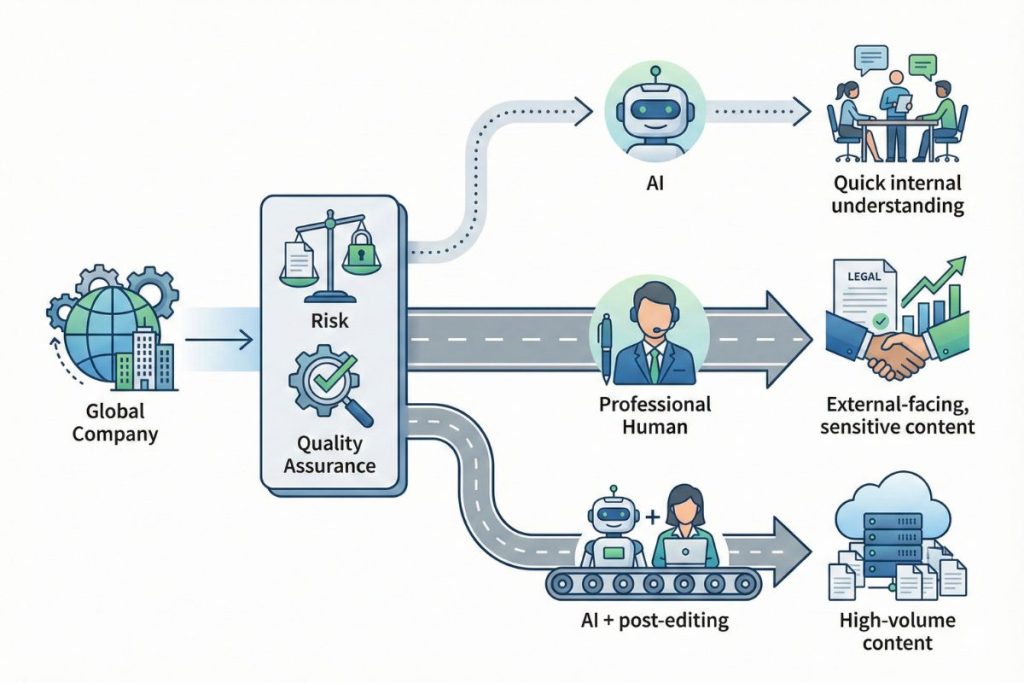
If you’re a global company entering Japan or managing Japanese business relationships, translation choices should be made based on (1) content risk (purpose + publishing scope) and (2) required quality assurance (review workflow, terminology consistency, operational continuity).
- Quick internal understanding (low risk) → Free AI tools may be acceptable
- External-facing, revenue-impacting, or legally sensitive content → Professional human translation (often with structured QA) is typically required
- High-volume content → AI + post-editing may be viable if you have defined QA standards
Free English to Japanese Translation Tools: When They Work (And When They Don’t)
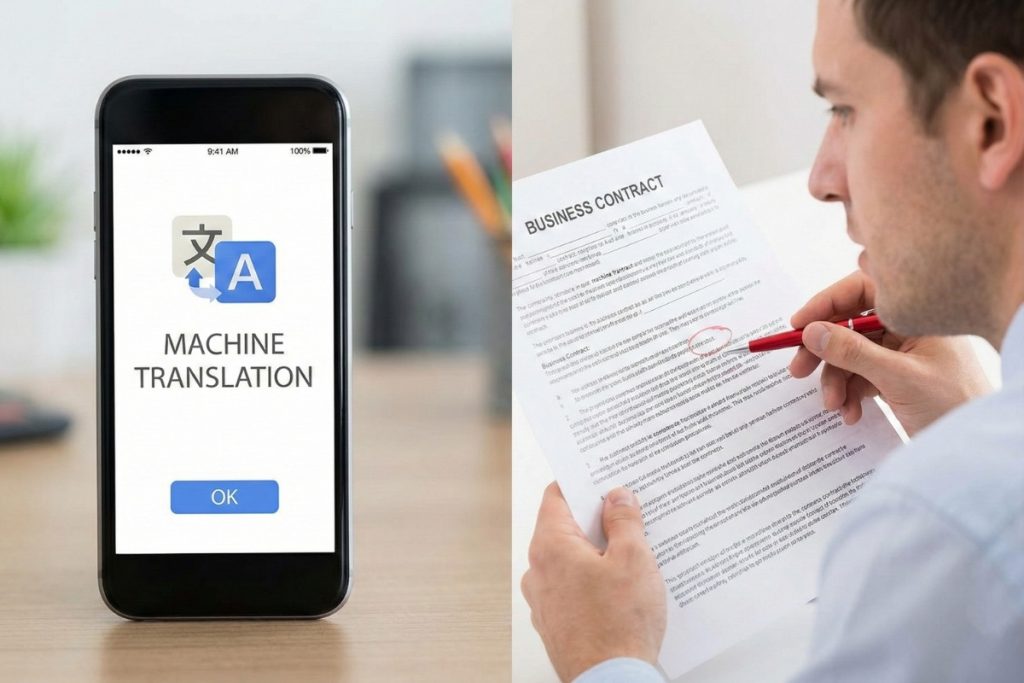
Understanding the strengths and limits of free translation tools helps you use them effectively—without creating avoidable business risk.
Free AI Translation Tools: Quick Feature Comparison
| Tool | Key Features / Strengths | Why It’s Convenient for Business Use | Common Pitfalls for EN→JA Business Translation |
| Google Translate | Broad feature set: text translation, voice translation, image/camera translation, offline language downloads; wide language coverage | Easy to use across devices; useful for quick internal comprehension and on-the-go reading (signs, screenshots, short passages) | Often lacks reliable control over Japanese formality (keigo) and business tone; may sound too direct or unnatural for customer-facing copy |
| DeepL | Often produces smoother, more natural-sounding output; formality/tone controls available in certain plans/languages; strong API options in paid tiers | Good for drafting and accelerating internal workflows; easier to refine than raw MT in many cases | Still needs human review for keigo, cultural nuance, and domain terminology; free-tier usage may be unsuitable for sensitive content depending on your policy requirements |
| Microsoft Translator (Azure Translator) | Strong enterprise integration with Microsoft ecosystem; supports real-time conversation scenarios and Office/Teams-adjacent workflows; clearer enterprise controls in paid offerings | Convenient for organizations already using Microsoft 365; easier operational rollout and integration | For high-stakes Japanese business content, human review is still needed for tone, keigo accuracy, and culturally appropriate messaging |
Google Translate: The Universal Standard
Google has stated that users translate more than 100 billion words per day with Google Translate.
Best Use Cases (Low Risk)
- Understanding Japanese emails for internal comprehension
- Getting the general meaning of Japanese web pages during research
- Translating simple internal messages where perfect tone and register aren’t critical
- Quick vocabulary checks for short phrases
Critical Business Limitations (Why It Becomes Risky)
For business Japanese, the major risks are less about literal meaning and more about:
- Formality and keigo level selection (a mismatch can sound disrespectful or unprofessional)
- Tone control (Japanese business writing often avoids directness and prioritizes nuance)
- Consistency (terminology and phrasing must stay stable across customer touchpoints)
These risks are amplified for external-facing content (marketing, product UI, contracts, policies), where “understandable” is not the same as “acceptable.”
DeepL: Often More Natural, Same Category of Risk
DeepL is widely used because it can produce smooth output, especially for certain sentence structures. However, for Japanese business communication, the key limitation remains: high-stakes writing requires consistent control of formality, nuance, and industry terminology across contexts.
Also note that DeepL’s Free Services Terms of Use explicitly warn against using the free service for confidential or personal data—this is important for contracts, customer data, and internal documents.
Microsoft Translator: Enterprise Integration + Clearer Data Controls (for Paid/Enterprise Use)
Microsoft Translator is attractive for companies already in the Microsoft ecosystem (Office/Teams). If privacy and retention are a concern, Microsoft provides “no trace”/data handling explanations for business/enterprise usage.
Microsoft also publishes data privacy/security notes for Azure Translator.
Even so, the same practical translation limitations apply for Japanese business content: formality and cultural adaptation still require human oversight for external-facing or brand-critical materials.
Quick Decision Guide: Choosing Your Translation Approach

Use this matrix to match your needs to the right approach:
| Translation Method | Business Risk Level | Best Use Cases | Critical Limitations | When NOT to Use |
| Free AI Tools (Google Translate / DeepL) | High risk for external use | Internal comprehension, research, quick checks | Tone/formality control, cultural nuance, terminology consistency, confidentiality concerns (esp. for free tools) | Customer-facing, legal, compliance, brand messaging |
| AI + Human Review (Post-editing / MTPE) | Medium | High-volume drafts, internal docs with defined QA, repeatable content | Can sound generic; requires governance (terminology + reviewers) | Brand-critical positioning, sensitive legal content |
| Freelance Translator | Medium (varies) | Small projects in a clear specialty area | Scalability and continuity depend on one person | Large multi-format launches, mission-critical deadlines |
| Translation Company (Agency) | Low (with QA) | Market entry, websites, legal/compliance, core marketing | More coordination required | One-off casual internal translation |
If you offer AI + post-editing as a formal workflow, consider aligning it with recognized process requirements such as ISO 18587 (post-editing of machine translation output).(Source:ISO)
The Hidden Cost of “Free” Translation (Business Perspective)

Free tools cost $0 to run, but they can introduce downstream costs through:
- Rework cycles and internal review burden
- Inconsistent terminology across content and teams
- Brand damage from unnatural or inappropriate tone
- Risk exposure if confidential content is processed using free/public systems
Because the risk is primarily context- and audience-driven, decisions should be based on business impact, not only convenience.
Why Japanese Translation Requires Specialized Expertise
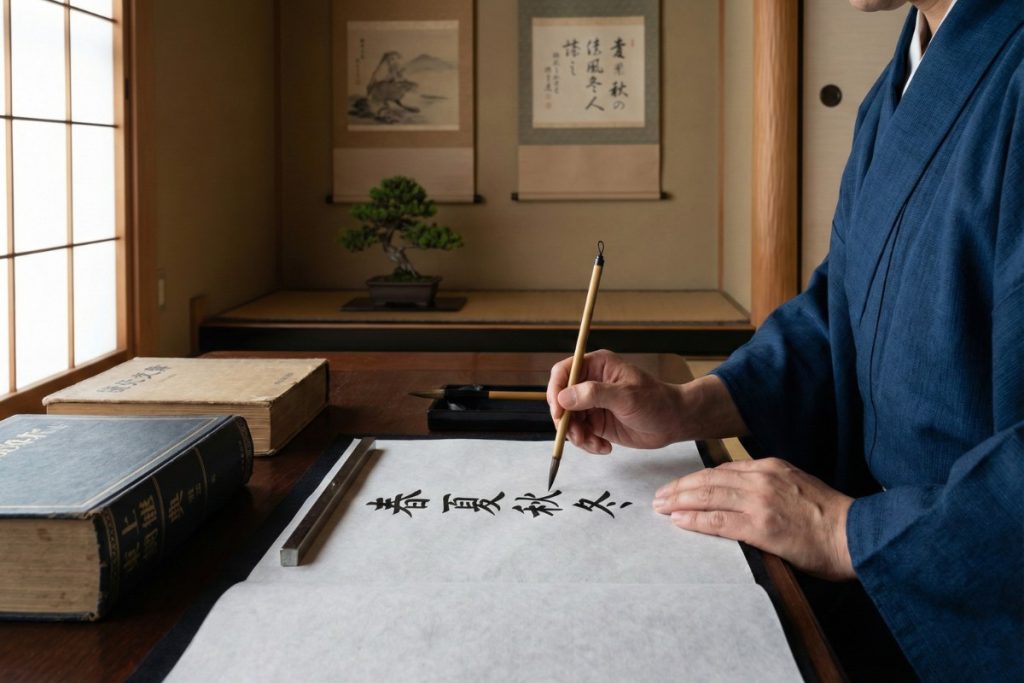
Japanese presents structural and cultural complexity that makes business translation particularly sensitive.
The Complexity of Japanese Formality (Keigo) Systems
Japanese has a grammatical system for expressing different levels of politeness, respect, and formality (keigo).
A typical business risk is not “wrong meaning,” but “wrong relationship framing” (e.g., overly casual, overly direct, or mismatched humility/respect).
High-Context Communication Culture
Japan is often described as a high-context culture, where meaning is frequently inferred from context rather than stated explicitly. BBC’s discussion of “reading the air” illustrates how indirect communication and inference are culturally embedded.(Source:BBC)
This matters because literal translations of Western business copy can sound too direct, pushy, or culturally tone-deaf—even when the English text is perfectly acceptable in its original market.
Industry Terminology and Regulated Content
Industry terminology in Japanese is not always a literal mapping from English (e.g., decisions about katakana loanwords vs. established Japanese terms). For regulated industries, translation quality becomes a compliance and risk-management issue, not just a linguistic one.
Professional English to Japanese Translation: Freelancers vs Companies

Once you’ve determined professional translation is necessary, the next decision is often between a freelance translator and a translation company.
Freelance Translators: Specialized Expertise
Quality assurance (e.g., multi-step review, terminology management, ongoing operational support) and delivery redundancy often depend entirely on a freelance translator. For external-facing or brand-critical translations, you should evaluate freelancers with the assumption that quality can vary and continuity risks may arise.
Advantages
- Deep specialization in specific industries or content types
- Direct communication can build context over time
- Potentially lower cost for small projects
Limitations
- Limited scalability for large or urgent projects
- Business continuity risk (availability depends on one person)
- QA processes may be informal unless explicitly agreed
Translation Companies: Systematic Quality and Scalability
Translation companies (professional agencies) typically deliver more consistent quality through standardized QA workflows and team-based production (e.g., Translation → Editing → Proofreading). A TEP workflow is commonly described as Translation, Editing, and Proofreading as core stages.
Organizations also often use translation memory ™ to reuse approved segments and improve consistency across content over time.
Advantages
- Repeatable QA processes and multi-person review
- Scalability for multi-format and high-volume projects
- Terminology and translation memory management for consistency
- Continuity and backup coverage
Considerations
- Higher coordination overhead than a single freelancer
- Requires careful vendor selection (process transparency matters)
Decision Framework
This section helps you choose between free AI tools, AI plus post-editing, freelance translators, and a professional translation company based on content risk and QA requirements.
Choose freelance translators for:
- Small, occasional translation needs
- Content clearly within the translator’s specialization
- Non-critical timelines that allow iteration
- Significant budget constraints
Choose translation companies for:
- Market entry with substantial content needs
- Business-critical or customer-facing content
- Large projects requiring scalability
- Situations where guaranteed quality and availability matter
- Teams lacking internal project management resources
How to Choose the Right English to Japanese Translation Partner

Selecting the optimal partner requires evaluating factors that directly affect business outcomes.
Essential Evaluation Criteria
1) Native Japanese Expertise + Industry Specialization
Native-level Japanese competence is essential for natural tone, appropriate formality, and cultural alignment—especially for customer-facing content.
2) Quality Assurance Processes
Look for process clarity and, when relevant, formal standards such as ISO 17100 (translation services requirements).
If you plan to use machine translation with post-editing at scale, ISO 18587 provides requirements for human post-editing workflows.
3) Communication & Cultural Bridge Capability
For teams without Japanese offices, you need partners who can communicate clearly in English while advising on Japanese expectations.
4) Technology Infrastructure (TM / Terminology Management)
Translation memory helps reuse prior approved translations, improving consistency and reducing repetitive work.
Red Flags to Avoid
- Vague QA steps (“we’ll check it”) without defined roles or review stages
- Resistance to providing samples or explaining workflow
- Unrealistically low pricing without explaining scope/QA
- Poor communication during the pre-sales stage
- Claims of equal expertise in every industry without evidence
Take Action: Accelerate Your Japan Market Success

The Japanese market offers tremendous opportunity for companies with the right approach to communication and cultural adaptation. Professional English to Japanese translation provides the foundation for building trust, credibility, and business relationships in one of the world’s most valuable markets.
Don’t let language barriers limit your Japanese market potential. The difference between “we tried Japan once” and “Japan became one of our strongest growth markets” often comes down to choosing the right translation approach.
Ready to discuss your Japanese translation needs?
Contact AtGlobal for:
- Free Consultation: Discuss your Japanese market goals and translation requirements
- Sample Translation: Receive quality demonstration for your specific content type
- Custom Proposal: Get detailed pricing and timeline for your translation projects
Visit us at:https://www.atglobal.co.jp/
Your success in Japan begins with communication that resonates authentically with Japanese audiences. Let AtGlobal help you make the right impression and build lasting business relationships in the Japanese market.
Frequently Asked Questions About English to Japanese Translation
- How long does professional English to Japanese translation take?
-
Professional translation typically takes 3-5 business days for a 5,000-word document. Translators handle 2,000-2,500 words daily through translation, editing, and proofreading stages. Website localization requires 1-2 weeks. Rush services with multiple translators are available at premium rates for urgent deadlines.
- What’s the difference between translation and localization for the Japanese market?
-
Translation converts text between languages. Localization adapts content for Japanese culture, including UI/UX design, currency formats, cultural imagery, and marketing messaging that resonates with Japanese consumers. Successful Japan market entry requires localization, not just translation, to compete effectively with local brands.
- How do professional translators ensure data security and confidentiality?
-
Professional agencies use NDAs and encrypted file transfers, never feeding client data into public AI systems. They maintain ISO 27001 certification and GDPR compliance. Unlike free tools that may retain content, professional services protect unreleased products, financial data, and regulated information through secure workflows.
- Do I need industry-specific translators for my business sector?
-
Yes. Industry-specialized translators combine linguistic expertise with professional backgrounds in finance, legal, medical, or technology fields. They understand precise terminology and regulatory requirements. Using generalist translators for specialized content often causes costly errors, compliance issues, or loss of credibility with Japanese audiences.
- Can English to Japanese translators handle business Keigo (honorific language)?
-
contexts. They apply Kenjougo (humble forms for your company) and Sonkeigo (respectful forms for customers). Machine translation cannot assess these cultural nuances, often producing disrespectful or unprofessional-sounding Japanese business communication.
- What file formats can professional translation services handle?
-
Professional agencies process all common formats: Microsoft Office, PDF, Adobe InDesign, HTML, XML, JSON, and mobile app files. Advanced CAT tools preserve original formatting, hyperlinks, and design elements, delivering publication-ready translated content without requiring manual reformatting or layout reconstruction.
- What’s the difference between certified and standard translation?
-
Standard translation serves most business needs: websites, marketing, documentation. Certified translation includes legal attestations of accuracy required for government submissions, court documents, or regulatory filings in Japan. Only credentialed translators with legal authorization can provide certified translation services.
English to Japanese Translator: Key Takeaways
- Match your translation method to content risk level
- Machine translation cannot handle Japanese keigo (honorific language)
- Japan’s high-context culture requires cultural adaptation, not literal translation
- “Cheap” translation creates hidden costs of hundreds of thousands of dollars
- Japan market entry demands localization beyond simple translation
- Industry-specialized translators are essential for technical accuracy
- Translation companies offer superior scalability and systematic quality assurance
- Professional services protect confidential data with NDAs and encryption