Complete Japanese Writing Translation Guide: Choosing Between AI, PEMT, Human & Transcreation
For global companies expanding into Japan, Japanese writing translation is a critical challenge that goes far beyond simple word conversion. The US State Department classifies Japanese as a “Category IV” language—requiring three times more learning hours than Spanish or French.
The complexity of Japanese writing translation isn’t just linguistic difficulty. It’s the simultaneous use of three scripts (Kanji, Hiragana, Katakana), intricate honorific systems that encode social hierarchy, and a high-context culture where meaning lives between the lines. A direct translation that works in New York can feel aggressive or untrustworthy to Japanese consumers.
This guide reveals the structural and cultural barriers of Japanese writing translation and helps you choose the right solution—from AI to human experts to transcreation—based on your content type, budget, and business goals. Let’s take the first step toward building a trusted brand in Japan’s demanding market.
- Why Japan’s three-script system (Kanji, Hiragana, Katakana) and honorific levels create structural translation complexity
- The differences in cost, speed, and quality between AI translation, PEMT, human translation, and transcreation
- How to select the optimal translation method based on content purpose (internal docs, legal, marketing)
- Why Japanese-specific SEO strategies and Cultural Intelligence (CQ) determine translation success or failure
目次
Why Japanese Writing Translation Is Uniquely Difficult for Global Companies
For many global companies, localization is a standard procedure in their expansion playbook. However, treating Japan as “just another language to translate” is a strategic misstep. The US State Department’s Foreign Service Institute classifies Japanese as a “Category IV” language—exceptionally difficult for native English speakers—requiring roughly three times as many learning hours as French or Spanish. But the challenge for businesses isn’t just linguistic difficulty; it is the inextricable link between language, social hierarchy, and consumer trust. Understanding these structural and cultural barriers is the first step in choosing a translation solution that protects your brand’s reputation.
The Three-Script System and Its Impact on Japanese Writing Translation
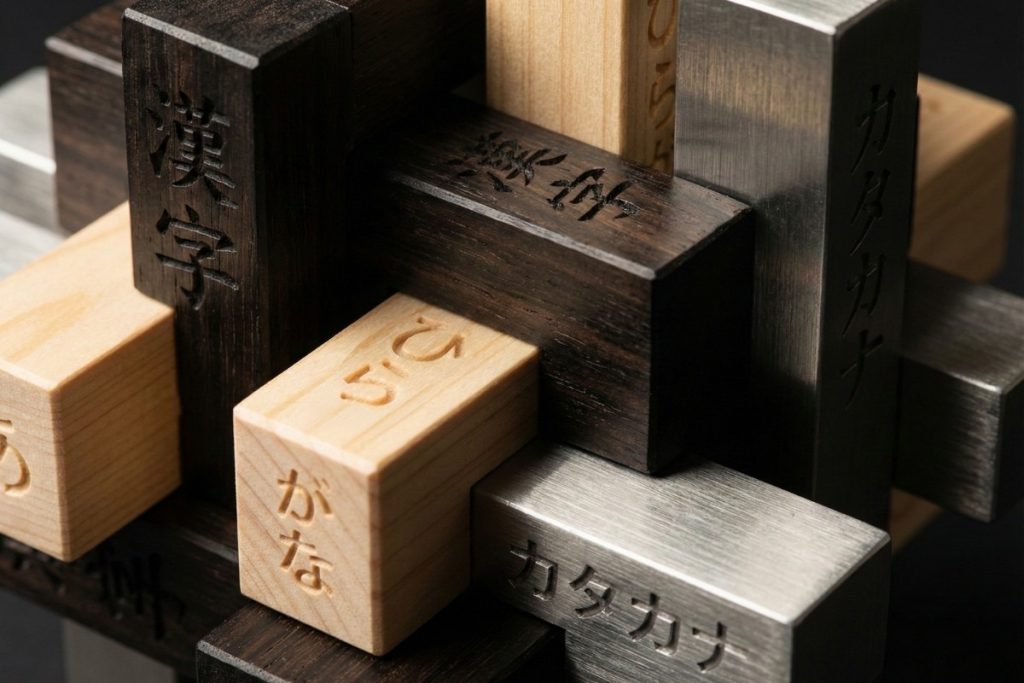
Unlike English, which relies on a single alphabet, written Japanese employs three distinct scripts simultaneously, each serving a specific function.
- Kanji (Chinese characters): Used for nouns, stems of verbs, and adjectives. They carry meaning and density.
- Hiragana: Used for grammatical particles and native Japanese words. It adds softness and flow to the text.
- Katakana: Used primarily for foreign loanwords, technical terms, and emphasis.
For a global brand, the balance between these three scripts is crucial. A text heavy on Kanji can appear stiff, academic, or overly masculine, potentially alienating a B2C audience. Conversely, a text relying too much on Hiragana might look childish or uneducated. “Katakana words” are ubiquitous in modern business (e.g., marketing becomes maaketingu), but overusing them can make a company seem lazy or incapable of finding the appropriate Japanese terminology. Professional translation isn’t just about swapping words; it is about orchestrating these three scripts to achieve the perfect visual and tonal balance for your target demographic.
High-Context Communication and Its Influence on Japanese Translation
Cultural anthropologist Edward T. Hall famously distinguished between “low-context” and “high-context” cultures. English-speaking cultures (especially the US) are typically low-context: communication is explicit, direct, and the message is in the words themselves. Japan is a high-context culture: communication relies heavily on implicit understanding, shared background, and non-verbal cues.
In writing translation, this difference is profound. A direct, persuasive sales copy that works in New York might sound aggressive, pushy, or unnaturally detailed to a Japanese reader. Japanese consumers often prefer “soft-sell” approaches where the benefits are suggested rather than shouted. Translating English copy word-for-word often strips it of the necessary ambiguity and politeness that Japanese readers expect, resulting in content that feels “foreign” and untrustworthy.
Keigo and Politeness Levels in Japanese Business Translation
Perhaps the most notorious hurdle in Japanese writing is Keigo—the complex system of honorifics. It is not merely about saying “please” or “thank you”; it is a grammatical coding of social hierarchy.
- Sonkeigo (Respectful language): Used to elevate the listener (customer or client).
- Kenjougo (Humble language): Used to lower the speaker (yourself or your company) to show respect.
- Teineigo (Polite language): Standard politeness used in general communication.
A single verb like “to eat” changes completely depending on who is eating and who is being addressed. In a business context, using the wrong level of politeness can be disastrous. Using standard polite language when humble language is expected can make a global enterprise appear arrogant or unrefined. Conversely, being overly polite can create distance and hinder friendly B2C relationships. Navigating this web of social nuance requires native-level intuition that goes far beyond simple dictionary definitions.
Translation Methods for Japanese Writing: AI, PEMT, Human, and Transcreation
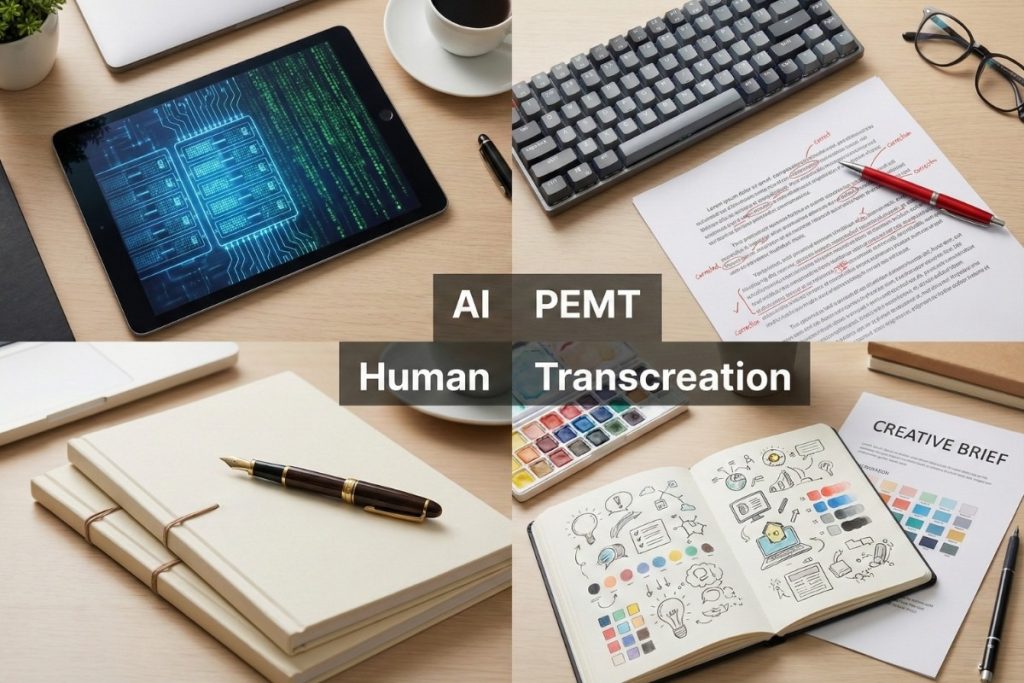
Once the complexities of the Japanese language are understood, the next step is navigating the marketplace of translation solutions. In 2026, the options range from instant algorithmic processing to highly creative copywriting. Choosing the right “Japanese writing translation” method is about balancing three variables: cost, speed, and quality (emotional impact). Here is the breakdown of the primary methodologies available today.
AI Translation and PEMT: Balancing Speed, Cost, and Nuance
With the evolution of Neural Machine Translation (NMT) and Large Language Models (LLMs) like DeepL, ChatGPT, and Gemini, the quality of automated translation has improved significantly. For getting the “gist” of a document, AI is unbeatable in terms of speed and near-zero cost.
However, for outbound business content, Raw AI poses significant risks. AI often struggles with the context-heavy nature of Japanese, frequently misinterpreting the subject of a sentence (which is often omitted in Japanese) or selecting the wrong politeness level. It can produce grammatically correct but “soulless” or slightly unnatural text—often referred to as “translationese.”
This has led to the rise of PEMT (Post-Editing Machine Translation). In this workflow, an AI generates a first draft, which is then reviewed and corrected by a human linguist. PEMT is a cost-effective middle ground for high-volume content like help center articles or product descriptions where functional clarity is more important than brand voice.
Human Translation for Japanese: Ensuring Accuracy and Consistency
This is the traditional and most reliable standard for corporate communication. Professional human translation involves native linguists who are also subject matter experts (SMEs) in specific fields like law, engineering, or finance.
Unlike AI, a human translator understands the intent behind the text. They ensure consistency in terminology—crucial for technical manuals or legal contracts—and can navigate complex sentence structures without losing the logical flow. For documents where accuracy is non-negotiable and liability is a concern, relying solely on human expertise is the industry standard. This method prioritizes fidelity to the source text while ensuring the Japanese output is natural and readable.
Transcreation for Japanese Marketing Content
When the goal is to persuade, inspire, or build a brand, standard translation is often insufficient. This is where Transcreation (Translation + Creation) comes in.
Transcreation is less about translating words and more about translating feelings and concepts. A catchy English slogan often falls flat when translated directly into Japanese. A transcreator might completely rewrite a headline, change a metaphor, or swap a cultural reference to ensure it triggers the same emotional response in a Japanese audience as the original did in the home market.
For example, a US ad campaign focused on “individual achievement” might need to be transcreated to focus on “harmony and team success” to resonate with Japanese values. This is the most expensive and time-consuming option, but for market-entry marketing materials, it yields the highest ROI.
Summary Table: Comparing Cost, Speed, and Quality
To help visualize which solution fits your immediate needs, refer to the comparison below:
| Methodology | Best For | Cost | Speed | Quality & Cultural Nuance |
| Raw AI | Internal memos, rough drafts, understanding incoming emails. | $ | High | Low (High risk of errors) |
| PEMT (AI + Human) | E-commerce listings, support articles, large-volume documentation. | $$ | Medium-High | Medium (Functional) |
| Human Translation | Legal contracts, technical manuals, corporate reports, official correspondence. | $$$ | Medium | High (Accurate & Polished) |
| Transcreation | Slogans, ads, website landing pages, brand messaging. | $$$$ | Low | Very High (Emotionally Resonant) |
How to Choose the Right Japanese Translation Method (Decision Framework)
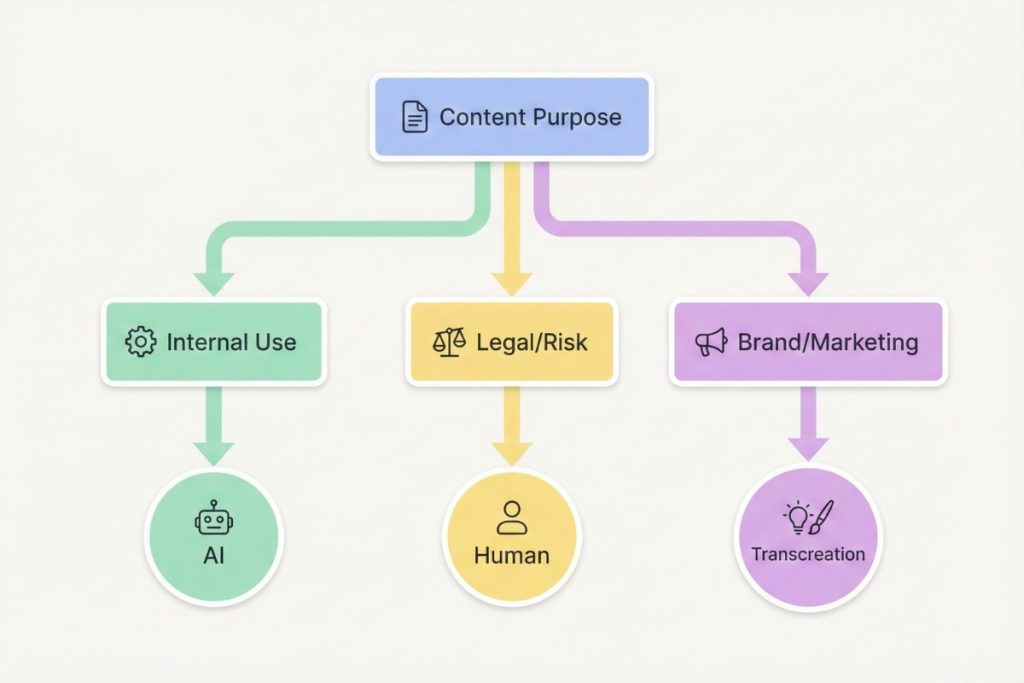
Smart budget allocation is key to a successful market entry. Not every sentence requires the touch of a creative copywriter, but using AI for high-stakes content can be fatal. To optimize your Japanese market strategy, we recommend a tiered approach based on content purpose and risk tolerance.
Scenario A: Using AI Translation for Internal and Low-Risk Content
Goal: Speed and Information Sharing.
Recommended Method: Raw AI or Light PEMT.
When the objective is simply to understand information or share non-critical updates within your internal teams, speed is the priority.
- Use Case: Internal emails between global branches, reading Japanese market news, or rough drafts of meeting minutes.
- The Strategy: Utilize secure, enterprise-grade AI translation tools to break down language barriers instantly.
- Caution: Ensure your AI tools are compliant with data privacy regulations. Never input trade secrets or sensitive personal data into public, free AI models. For internal memos that employees must act upon, a quick human review (Light PEMT) is recommended to prevent misunderstandings caused by AI hallucinations.
Scenario B: Human Translation for Legal, Technical, and Compliance Content
Goal: Precision, Liability Protection, and Safety.
Recommended Method: Professional Human Translation (Subject Matter Expert).
In Japan, details matter. A mistranslation in a user manual can lead to safety hazards, while ambiguity in a contract can result in voided agreements or lawsuits.
- Use Case: Contracts, Terms of Service, financial reports, medical device manuals, software UI (User Interface) strings, and patent filings.
- The Strategy: Do not cut corners here. Employ human translators who are specialists in the specific field. For instance, a legal translator understands the difference between “shall” and “may” in a Japanese legal context—a nuance AI frequently misses.
- Why Not AI?: AI struggles with consistency across long documents and lacks the accountability required for compliance. The cost of a human expert is an insurance policy against future litigation.
Scenario C: Transcreation for Branding, Advertising, and Web Content
Goal: Engagement, Conversion, and Brand Loyalty.
Recommended Method: Transcreation.
This is where your business actually interacts with the Japanese consumer. The Japanese market is notoriously demanding regarding quality; a typo or unnatural phrase on a landing page signals a “fake” or “low-quality” company.
- Use Case: Homepage copy, social media posts, advertising slogans, email marketing campaigns, and product packaging.
- The Strategy: Treat this as “Japanese Copywriting” rather than translation. Give the linguist a creative brief explaining the emotion and target audience rather than just the source text.
- The ROI: While this method has the highest upfront cost, it drives the highest conversion rates. A message that resonates culturally builds trust—the most valuable currency in Japanese business.
SEO and Cultural Intelligence (CQ) in Japanese Writing Translation
In the digital age, “Japanese writing translation” is rarely just for print; it is for the web. This introduces two invisible layers that dictate success: whether search algorithms rank your content (SEO) and whether local users trust it (CQ). Ignoring these layers is why many global brands see low traffic and high bounce rates despite having “correct” translations.
Why Literal Translation Fails in Japanese SEO
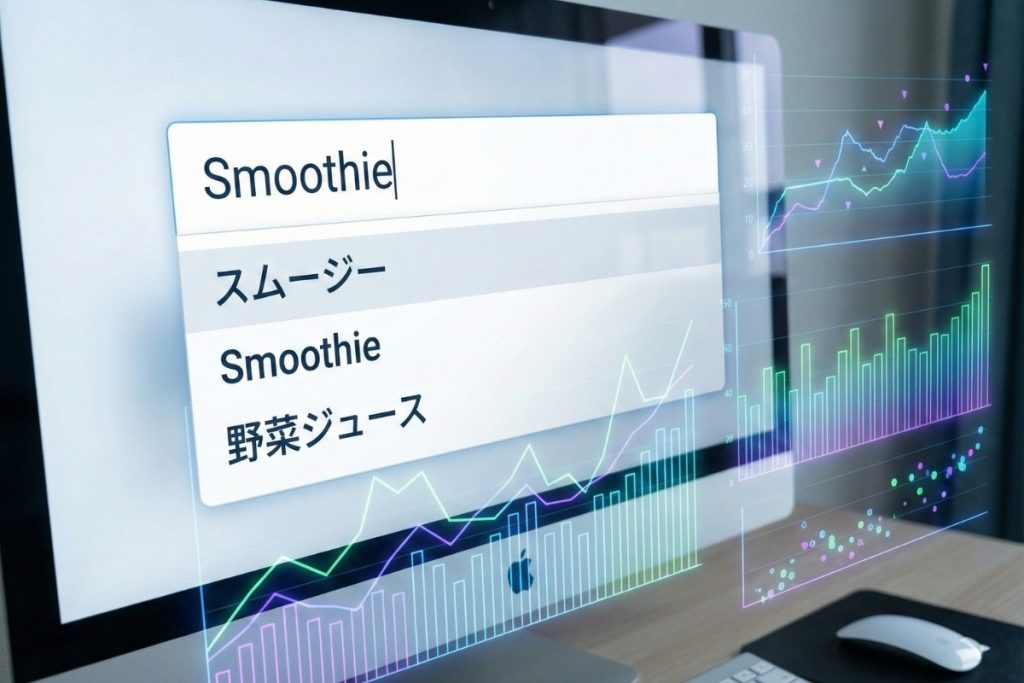
Japanese SEO is uniquely complex because of the multi-script writing system. A single English keyword can often be searched in three or four different ways in Japan.
For example, a user looking for a “smoothie” might type:
- Katakana: スムージー (Most common for casual products)
- Alphabet: Smoothie (Rare, but used by some enthusiasts)
- Hiragana/Kanji hybrid: Specific descriptive phrases.
If you simply translate your English keywords directly, you might target a term that no one actually searches for. A classic pitfall is the term “Remote Work.” In English, it is standard. In Japan, the market fluctuated between “Remote Work” (rimooto waaku) and “Telework” (terewaaku) for years. If you optimized for the wrong one during a specific timeframe, you missed the majority of the traffic.
Effective Japanese SEO requires Keyword Research, not Keyword Translation. You must analyze search volumes in Japan to identify the actual terms potential customers use, which often differ significantly from the direct dictionary translation of your English keywords.
Cultural Intelligence (CQ) and Message Adaptation for Japan
Cultural Intelligence (CQ) is the capability to relate and work effectively across cultures. In the context of writing, it means understanding the unspoken rules of Japanese communication.
Japanese society values harmony (Wa), trust, and safety. Aggressive “Call to Actions” (CTAs) that work in the US—like “Don’t miss out!” or “Sign up now!”—often trigger skepticism in Japan. They can feel like high-pressure sales tactics, which Japanese consumers tend to avoid.
A translator with high CQ knows that a Japanese user often needs more information and reassurance before making a decision. Instead of a short, punchy landing page, a Japanese landing page is often longer, providing detailed specifications, “User Voices” (testimonials), and Q&A sections to alleviate anxiety. “Translation” changes the language; “CQ” changes the structure and flow to match the local decision-making process.
Case Study: Tone of Voice and Conversion Rates in the Japanese Market
Consider the case of a B2B SaaS platform entering the Japanese market.
- Original English Copy: “You can boost your team’s productivity by 50% with our tool. Get started today.” (Direct, “You”-focused, benefit-driven).
- Direct Translation: Grammatically correct, but it sounded demanding to Japanese managers. The conversion rate was low.
- CQ-Optimized Rewrite: “Many companies have improved their team’s efficiency by introducing this system. Would you like to view the details?” (Social proof-driven, softer tone, indirect).
The Result: The CQ-optimized version saw a significantly higher Click-Through Rate (CTR). By shifting the focus from “You” (which can feel confrontational) to “Many companies” (invoking the desire to align with industry standards), the copy aligned with the Japanese preference for consensus and proven results. This demonstrates that in Japan, how you say it is just as important as what you say.
AtGlobal’s Integrated Approach to Japanese Market Entry

Solving the puzzle of Japanese writing translation requires more than a dictionary; it requires a map of the market. This is where AtGlobal distinguishes itself from traditional translation agencies. We define ourselves not as a language vendor, but as a comprehensive partner for overseas business expansion. Our methodology integrates linguistic precision with market strategy to ensure your entry into Japan is seamless and successful.
Integrating Market Research with Japanese Translation Strategy
Many global companies make the mistake of translating their content before validating their market fit. They spend thousands on localizing a website, only to find that the product positioning itself needs adjustment for the Japanese consumer.
AtGlobal reverses this process. We begin with Market Research. Before a single line of code is localized, our team investigates the competitive landscape, consumer preferences, and search behaviors in Japan. By understanding who your audience is and what they value, we can tailor the translation strategy—whether to use technical jargon or friendly colloquialisms—based on data, not guesswork. This ensures that the Japanese writing we produce is not just linguistically correct, but commercially viable.
End-to-End Support: Localization, Digital Marketing, and Sales Enablement
Translation is often treated as an isolated task, separated from marketing and sales. In reality, they are parts of the same ecosystem. AtGlobal offers a “One-Stop Solution” that connects these dots.
- Localization: High-quality translation and transcreation for websites, software, and documents.
- Digital Marketing: We don’t just translate your SEO keywords; we manage your Japanese SEM (Search Engine Marketing) campaigns, social media accounts, and content marketing strategies.
- Sales & Cultural Support: From arranging interpreters for business meetings to providing CQ (Cultural Intelligence) training for your expatriate staff, we support the human side of your business.
This integrated approach means you do not need to manage multiple vendors—one for translation, one for SEO, and another for market research. AtGlobal unifies the voice of your brand across all channels.
Why Choosing a Strategic Partner Matters for Japanese Market Entry
A “vendor” delivers a file and sends an invoice. A “partner” is invested in your KPIs. Entering the Japanese market is a long-term commitment; trust is built slowly, and relationships are paramount.
AtGlobal operates as an extension of your team. We proactively suggest improvements—for example, advising you that a certain color scheme on your brochure might carry negative connotations in Japan, or that your web form is asking for information that Japanese users are hesitant to provide. By choosing a partner with deep local roots and a global mindset, you gain a safety net against cultural faux pas and a strategic advisor committed to your sustainable growth in the world’s third-largest economy.
Future Trends in Japanese Translation: 2026 and Beyond

As we move through 2026, the landscape of language services is evolving rapidly. The binary debate of “Human vs. AI” has largely settled into a more nuanced reality: “Human with AI.”
Human-in-the-Loop AI Workflows for Japanese Translation
By 2026, generic translation models have been superseded by domain-specific AI engines trained on proprietary corporate data. However, as AI capability grows, so does the premium on authenticity. Japanese consumers, bombarded by AI-generated content, are becoming increasingly sensitive to the “warmth” of human communication.
The winning formula for the coming years is the Human-in-the-Loop (HITL) model. In this workflow, AI handles the heavy lifting of volume and vocabulary consistency, while human experts—acting as cultural gatekeepers—refine the nuance, tone, and emotional resonance. This hybrid approach allows global businesses to scale their Japanese content velocity without sacrificing the brand integrity that is so vital in this high-trust market.
FAQ: Japanese Translation, Costs, Processes, and Best Practices

- How much does professional Japanese translation cost per word?
-
Rates vary significantly based on the complexity of the content and the level of service required. In general, professional business translation ranges from $0.18 to $0.25+ USD per source word in the 2026 market. Lower rates often indicate “blind” translation by inexperienced freelancers or raw AI output, which risks accuracy. Higher rates typically cover Subject Matter Experts (SMEs) in legal or medical fields and include multi-step Quality Assurance (T-E-P: Translation, Editing, Proofreading). For creative marketing (Transcreation), pricing is often project-based or hourly, as it involves copywriting rather than simple word-for-word replacement.
- What is “Back Translation” and do I need it for my Japanese documents?
-
Back translation involves taking the translated Japanese text and having a second, independent linguist translate it back into English. This process helps verify accuracy and identify discrepancies in meaning. It is a standard requirement for high-risk industries like pharmaceuticals (clinical trials), legal contracts, and financial reporting where precision is mandatory and liability is a concern. However, for marketing or creative content, back translation is widely discouraged. It tends to flag culturally adapted nuances as “errors” because creative Japanese copy rarely aligns literally with the original English source.
- Can I translate English directly into Japanese dialects (like Osaka-ben)?
-
Standard Japanese (Hyo-jun-go) is the default for business communication and is understood nationwide. However, utilizing dialects like Osaka-ben (associated with humor, friendliness, and commerce) can be a powerful branding tool for B2C campaigns aiming for a deep “local” connection. That said, using dialects carries high risk; if used incorrectly by a non-native brand, it can feel mocking, unnatural, or inauthentic. It requires a specialist transcreator native to that specific region. For most initial market entries, sticking to Standard Japanese is the safest and most professional route to build trust.
- How do you handle Japanese character limits in UI/UX design?
-
Japanese text generally contracts in length compared to English (often using 20-50% fewer characters), but visually, it takes up more horizontal space because Japanese characters are “double-byte” (full-width). For example, a short English word like “Go” might become “移動” (Move) or “実行” (Execute). While the character count drops, the font size and line height often need adjustment for readability. We recommend “pseudo-localization” testing during the design phase to spot layout breaks. Additionally, developers must ensure the UI supports UTF-8 encoding to prevent characters from turning into illegible “tofu” blocks (garbled text).
- s there a difference between translating for print vs. digital in Japan?
-
Yes, the medium dictates the tone significantly. In Japan, print materials (brochures, business cards, official reports) traditionally hold a higher status of authority and permanence. Consequently, the translation style for print tends to be more formal, utilizing stiffer Kanji compounds and strict Keigo (honorifics). Digital content, especially on mobile, prioritizes scannability, speed, and user engagement. Web writing often uses more Hiragana and Katakana to create visual “white space” and a friendlier tone. Treating a website translation with the stiffness of a printed legal document is a common UX mistake that increases bounce rates.
Conclusion: Key Insights on Japanese Writing Translation
- Japanese employs three distinct scripts—Kanji, Hiragana, and Katakana—simultaneously, and their balance directly impacts audience perception and brand image
- Japan is a “high-context culture” where direct English expressions translated literally often feel aggressive or unnaturally detailed
- Misusing Keigo (honorific levels: respectful, humble, polite) can make a company appear arrogant or untrustworthy
- AI translation excels in speed and cost but carries significant risk of errors in context interpretation and politeness level selection
- Legal and technical documents require expert human translation, while marketing copy demands transcreation that recreates emotional impact
- Japanese SEO requires keyword research, not just translation, as the same concept can be searched in multiple scripts (Katakana, alphabet, Kanji)
- The Japanese market values harmony, trust, and social proof—aggressive CTAs typically backfire
- In 2026, the Human-in-the-Loop model combining AI efficiency with human cultural expertise has become the mainstream approach