Quality Over Cost: A Guide to Professional Japanese Document Translation Services
When expanding into the Japanese market, choosing the right partner for Japanese document translation services is one of the most important decisions your business can make. Many companies initially compare prices when selecting a translation vendor, but in reality, the true value of translation lies not in cost, but in quality. A single mistranslated phrase can cause misunderstandings, legal risks, or even harm to your brand reputation in Japan.
High-quality Japanese document translation services ensure not only accurate language conversion, but also cultural sensitivity, industry-specific precision, and compliance with professional standards. In this article, we will explain why quality matters more than price, what defines a reliable translation company, and how to choose a long-term partner that protects your business and strengthens your communication in the Japanese market.
- Importance of prioritizing translation quality over price in Japanese document translation services
- Risks of inaccurate or culturally inappropriate translations damaging business and brand reputation
- Essential elements of quality translation including human expertise, QA process, and industry specialization
- Criteria for selecting a reliable long-term partner providing secure and consistent Japanese document translation services
目次
The Hidden Dangers of Cheap Japanese Document Translation Services
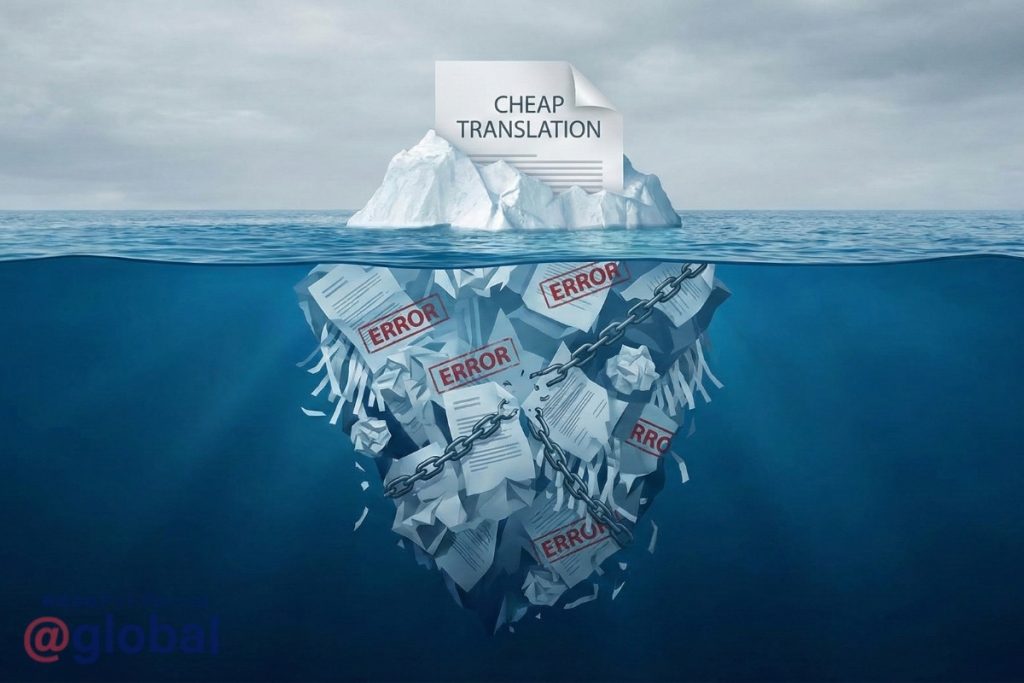
To understand why quality is paramount, we must first be honest about the risks. Choosing a translation vendor based on price alone is a gamble, and in the meticulous Japanese market, the odds are not in your favor. The “savings” from a low-cost provider can be erased a hundred times over by a single, preventable error.
Inaccuracy and the “Uncanny Valley” of Machine Translation
The most obvious danger is simple inaccuracy. Cheap services often cut corners by relying heavily on raw machine translation (MT) or using non-native, unvetted translators. They miss context, fail to understand idioms, and mistranslate industry-specific jargon.
The result is a document that isn’t just “a little off.” It’s functionally useless and often nonsensical. But even more insidious is the “uncanny valley” of a poor translation—it’s almost right, but just wrong enough to be confusing, awkward, or factually incorrect. This signals to your Japanese partners that you didn’t care enough to get it right. It’s a sign of disrespect, and it immediately erodes trust.
The Structural Barrier: Why Japanese is a Unique Challenge for AI
Unlike translation between Indo-European languages—such as English, French, or Spanish—Japanese possesses a grammatical structure fundamentally different from English. Japanese is a “high-context” language where subjects are frequently omitted; for example, a sentence like “行きます” (“I will go”) leaves the subject implicit.
Current AI translation systems lack the human ability to “read the air,” often leading to critical mistranslations. Even if the output looks correct at the word level, the overall coherence often breaks down, or the subject-object relationship—who is doing what to whom—can be completely reversed. Without the oversight of a skilled human translator, such systemic issues can produce output that sounds fluent yet fails to meet professional or cultural expectations.
Losing Business Nuance: The “Keigo” Catastrophe
This point – the impoortance of proper Keigo- cannot be overstated. Japanese communication is built on a complex system of politeness levels and honorifics known as Keigo (謙譲語, 丁寧語, 尊敬語). This isn’t just about saying “please” and “thank you.” It’s an intricate linguistic structure that defines the relationship between the speaker, the listener, and the person being discussed.
Using the wrong level of Keigo can seriously damage business relationships.
- Too casual: You sound arrogant, ignorant, and deeply disrespectful to a potential client or partner.
- Too self-deprecating (or an incorrect form): You can sound servile, confusing, or simply foolish.
A cheap translation service, especially one using a translator who isn’t a native speaker or who is unfamiliar with business-specific protocols, will get this wrong. They will flatten your carefully crafted message, or worse, inject a tone that is offensive.
Your negotiation, your partnership, your entire business relationship can be poisoned before it even begins, all because your translator didn’t understand the nuance between a casual, direct translation like anata no kaisha (あなたの会社, “your company”) and the required business-respectful term onsha (御社, “your esteemed company”).
Legal and Compliance Risks
For “document translation,” the stakes are often legally binding. Consider the source documents: contracts, patents, financial statements, clinical trial data, regulatory submissions, or employee safety manuals.
A single mistranslated word in a legal contract can change a “shall” to a “may,” which in legal contexts can shift obligations from mandatory to optional, potentially voiding enforceability. An error in a patent application can invalidate your intellectual property claim in Japan. A mistake in a compliance manual or a product’s safety instructions can lead to regulatory fines, product recalls, lawsuits, and, in the worst-case scenario, physical harm to an end-user. These are not theoretical risks; they are concrete, multi-million-dollar liabilities. A professional, quality-controlled Japanese translation company is your best insurance against errors.
Damaging Your Brand: The Peril of a Bad First Impression
In a market that prizes quality and attention to detail, your brand is your most valuable asset. Your Japanese website, your marketing brochures, your product packaging, and your press releases are your brand’s first ambassadors.
If this “first impression” is riddled with typos, unnatural phrasing, or culturally inappropriate imagery, your brand is immediately perceived as cheap, unprofessional, and out of touch. You look like you’re cutting corners. You look like you don’t understand or respect the Japanese market. This damage to your brand’s reputation is incredibly difficult to undo. You will have failed before you even had a chance to compete.
Professional Japanese document translation services are critical for companies expanding into Japan, especially in industries such as pharmaceuticals, legal, manufacturing, and fintech, where a single mistranslation can lead to regulatory or financial consequences.
What Does “Quality” Actually Mean in Japanese Document Translation Services?
Now that we’ve established the high cost of low quality, let’s define the solution. “Quality” is an overused word. In the context of English to Japanese translation, it has a very specific, tangible meaning. It is a multi-faceted concept that goes far beyond simply swapping words.
Linguistic and Cultural Accuracy
This is the cornerstone of quality. It is not enough for the translation to be grammatically correct. It must be culturally and contextually perfect. This is the difference between simple “translation” and “localization.”
Localization means the final Japanese document reads as if it were originally written in Japanese, for a Japanese audience. The translator must do more than just translate; they must:
- Adapt cultural metaphors: A reference to a “home run” in a business memo might be well received in Japan due to the popularity of baseball, but idioms like “kick the bucket” or “elephant in the room” may not translate well and could confuse the reader entirely.
- Localize examples: Dates, times, currencies, and units of measure (e.t., Celsius, metric system) must be converted.
- Preserve the intent: The translator must understand why the source text was written. Is it to persuade? To inform? To command? The Japanese text must achieve the same goal as the English original, even if it has to use different words or sentence structures to get there.
Human Expertise: The Non-Negotiable Element
“Quality” means a professional Japanese translation service that is built on a foundation of human expertise. Machine translation is a tool, but it is not a translator. Only a professional, native-speaking human linguist can:
- Understand subtle context.
- Appreciate irony, humor, or sarcasm.
- Navigate the complexities of Keigo.
- Make creative choices to ensure the message resonates.
Quality means your documents are handled by certified, native-speaking Japanese linguists who are also masters of the English language. They are a “human bridge” who can grasp the deepest nuances of your source document and perfectly reconstruct them in their native tongue.
Industry-Specific Knowledge
This is a critical “deciding factor” that separates a generalist from a professional. The person who translates your creative marketing slogans should not be the same person who translates your pharmaceutical patent.
A true quality provider doesn’t just offer “Japanese translation.” It offers:
- Legal Translation: Handled by linguists with law degrees or paralegal experience who understand the specific terminology of both US/UK common law and Japanese civil law.
- Medical & Life Sciences Translation: Handled by experts (PhDs, MDs) who are familiar with medical terminology, regulatory processes (PMDA), and clinical trial protocols.
- Technical & IT Translation: Handled by engineers and IT specialists who understand software strings, engineering specs, and technical manuals.
- Financial Translation: Handled by experts familiar with IFRS, J-SOX, and the specific language of financial reporting.
When you’re evaluating a provider, don’t just ask if they translate for your industry. Ask who will be doing the translation and what their specific subject-matter expertise is.
For web-facing documents, it’s also important to consider Japanese SEO practices. Literal keyword translation often fails to capture local search intent, making native expertise essential not only for linguistic accuracy but also for discoverability.
Confidentiality and Security
This is a component of quality that is often overlooked until it’s too late. Your corporate documents—contracts, M&A plans, R&D data—are highly sensitive.
A quality-focused Japanese translation company doesn’t just deliver good text; it delivers a secure process. This includes:
- Robust NDAs: Signed by all employees and all freelance linguists.
- Secure Infrastructure: Using secure, encrypted portals for file transfer, not unsecured email.
- Data Privacy: Strict policies that forbid a translator from, for example, pasting your confidential contract into a public machine translation engine to “speed things up.”
When you choose a cheap, unknown vendor, you have no idea where your confidential data is going. A professional agency makes data security a core part of its service.
Key Deciding Factors: How to Choose a Reliable “Japanese Translation Company”
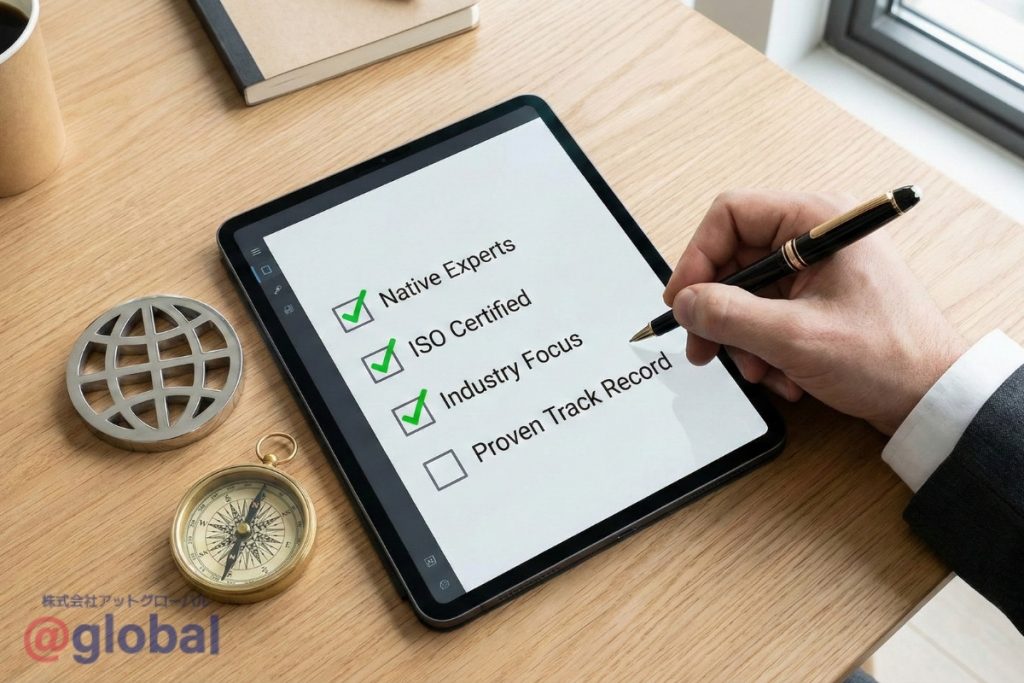
You are now armed with the “why” (the risks of failure) and the “what” (the definition of quality). Now, let’s move to the “how.” When you are researching providers, how do you separate the professionals from the pretenders? Here is a practical checklist of deciding factors, designed to help you find a true partner.
Do They Have Proven Subject-Matter Experts?
As discussed, this is critical. Don’t be afraid to dig deep.
- Bad Question: “Do you do legal translation?” (Everyone will say yes.)
- Good Question: “What is your vetting process for your legal translators? Can you provide an anonymized resume or a summary of qualifications for the type of linguist who would handle our specific project, such as ‘maritime law contracts’?”
A professional Japanese translation agency will be proud to tell you about its team. They will have a rigorous vetting process that tests for linguistic skill, industry knowledge, and professionalism. A low-quality vendor will be vague.
What is Their Quality Assurance (QA) Process?
This is the most important question you can ask. A single-pass translation, even by a great translator, is never enough. Humans make mistakes. A professional process is designed to catch them.
The industry-standard model is TEP: Translation, Editing, Proofreading.
- Translation: The initial translation is performed by a native-speaking, subject-matter expert.
- Editing: The translated document is reviewed in full by a second, separate senior linguist. This editor checks for accuracy against the source, consistency of terminology, tone, style, and cultural appropriateness. This is the most critical QA step.
- Proofreading: A final check is done to catch any remaining typographical errors, formatting issues, or minor mistakes before delivery.
If a potential vendor cannot clearly and confidently describe their multi-step QA process, do not hire them. They don’t have one.
Can They Provide “Certified Japanese Translation Services”?
Ask if the agency can provide a Certificate of Accuracy.
It’s important to understand that Japan does not have a single, official government certification system for translators (unlike some countries). However, a professional agency must be able to provide a signed declaration (a “Certificate of Accuracy”) attesting to the translation’s completeness and accuracy. This is often required for documents submitted to governments, courts, or universities outside of Japan.
Even if your current project doesn’t require certification, ask the question. A company that has the processes in place to provide certified translations is a company that operates at a higher, more accountable standard of quality.
Do They Have Client Testimonials and Case Studies?
Social proof is powerful. But look deeper than a few logos on a homepage.
- Weak Evidence: A one-sentence, anonymous quote like, “Great service!”
- Strong Evidence: A detailed case study from a company in a similar industry to yours. It should describe the client’s original problem, the process the agency used to solve it, and the successful outcome.
- Strong Evidence: Public-facing testimonials on B2B review sites (like Clutch or G2) or a willingness to connect you with a current client for a reference.
A long-term, professional partner will have a portfolio of happy clients who are willing to vouch for the quality of their work.
Why the Best Japanese Document Translation Services Offer More Than Just Translation

There is a final, “pro-level” tier of service that separates a good vendor from a true strategic partner. The best Japanese translation services understand that you are not just buying words; you are buying a solution. They provide a managed service that integrates with your business and makes your life easier.
Dedicated Project Management
A dedicated Project Manager (PM) is your single point of contact and your quality-of-life advocate. A PM is a “translation-expert-on-your-team” who:
- Takes the time to learn your business, your brand’s style guide, and your preferred terminology.
- Manages the entire workflow: vets and assigns the perfect linguist(s), manages the TEP process, and handles all deadlines.
- Saves you from having to re-explain your needs every time you have a new project.
This seamless management is an invisible but invaluable part of a quality service.
Flexibility and Turnaround Time
This may seem counter-intuitive, but a professional service is often faster and more reliable when you’re in a pinch.
- A cheap vendor is “fast” because it cuts corners (e.g., uses raw MT). If you give them a 50-page rush job, they will fail and deliver unusable garbage.
- A professional agency is fast because it has a process and a deep bench of vetted experts. They can handle that same 50-page rush job by assigning a managed team of three translators and one editor, all working from the same TM and glossary to ensure consistency. They are built to scale.
Quality means reliability. It means they meet their deadlines and the delivered product is flawless, every time.
For Japanese document translation services, AtGlobal is here to support you
As this article has detailed, choosing a translation partner for your critical Japanese documents is a high-stakes, strategic investment. The decision should not be based on price, but on proven quality, verifiable security, and deep expertise.
AtGlobal was founded on these exact principles. We are not just another vendor; we are the long-term, high-reliability partner for some of the world’s most demanding companies, including over a decade of continuous, large-scale projects for GAFAM clients.
Our commitment to excellence is not just a promise; it is embedded in our daily operations and verified by international standards:
- For Quality: We are ISO 17100 certified, the global standard guaranteeing a professional, multi-step quality assurance process for translation services.
- For Security: We are certified to ISO 27001 standard (ISMS) and have Privacy Mark certification, demonstrating our robust framework for information security and protecting your confidential data.
- For Modern Workflows: We declare conformity with ISO 18587, the international standard for machine translation post-editing, integrating technology with human expertise.
When you cannot compromise on quality or security, you need a partner with a proven system. Entrust your critical Japanese document translation needs to AtGlobal.
Common Questions About Japanese Document Translation Services
Here are answers to some of the most common practical questions clients ask when searching for a professional translation provider.
- How are costs for Japanese document translation services calculated?
-
Pricing models vary, but the most common method for English-to-Japanese translation is charging per source word (the number of words in your English document). Some services charge per target Japanese character, but this is less predictable for budgeting.
Per-page pricing is generally reserved only for standardized documents like certificates, while per-hour rates are rare and usually apply to complex editing or desktop publishing (DTP) tasks. Always ask for a clear, itemized quote based on your source document’s word count and subject-matter complexity to ensure transparency and avoid any surprises.
- What is a realistic turnaround time for a 10,000-word document?
-
A realistic turnaround for a high-quality, 10,000-word technical translation is typically 9 to 10 business days. This standard professional timeframe accounts for the full TEP (Translation, Editing, Proofreading) process: about 5 days for the initial translation by a subject-matter expert (approx. 2,000 words/day), 3 days for the separate review by a senior editor, and 1 day for final proofreading and quality assurance. Services promising it significantly faster are likely cutting corners by skipping the crucial editing step, which compromises quality.
However, it is possible to shorten the timeline while still maintaining quality—for example, by adjusting workflows or assigning additional resources. A reliable translation vendor can propose a solution tailored to your specific needs.
- What file formats can I submit?
-
While agencies can accept PDFs to provide a quote, they will almost always request the original, editable source files for the actual translation. This includes formats like .docx (Word), .pptx (PowerPoint), .xlsx (Excel), .indd (Adobe InDesign), or .ai (Adobe Illustrator).
Translating directly from editable files is crucial because it allows the team to overwrite the text while preserving your layout and formatting. Submitting a non-editable PDF will add time and cost, as the document will first need to be converted or manually reformatted by a desktop publishing (DTP) specialist.
- What is the step-by-step process for a new client?
-
For most professional agencies, the client process is straightforward:
- Quote: You securely submit your document(s) via a portal or email.
- Analysis: The agency analyzes the word count, subject matter, and formatting to provide a firm quote and timeline.
- Kick-off: Once you approve, a dedicated Project Manager (PM) is assigned. You provide any style guides or glossaries.
- TEP: The project undergoes the full Translation, Editing, and Proofreading workflow.
- Delivery: The PM delivers the final translated document in its original format.
- Review: You typically have a set period (e.g., 14-30 days) to review and ask questions or request adjustments.
- Do you also handle Japanese to English document translation?
-
Yes, most full-service, professional Japanese translation companies offer bidirectional services. While this article focuses on the common corporate need for English-to-Japanese translation (localization for market entry), handling Japanese to English translation is a standard and essential capability. This is vital for clients who need to understand documents from their Japanese partners, such as contracts, internal reports, or technical feedback. The same quality principles apply: the agency must use native English speakers with specific subject-matter expertise (e.g., legal, financial) to ensure a fluent and accurate translation from Japanese.
- What happens if I need revisions or updates after delivery?
-
Reputable agencies include a client review period after delivery. Typically, you have a window (e.g., 14 or 30 days) to review the translation with your team and request any adjustments or clarifications, which are handled at no extra charge. For minor future updates to the original document (e.g., changing a few sentences in next year’s user manual), the agency uses its Translation Memory (TM). This database of your approved translations means you only pay for the new or changed sentences to be translated, not the entire document again, saving you significant time and money.
Final Thoughts on Choosing Japanese Document Translation Services
- It is essential to understand that in Japanese document translation services, quality matters more than price
- Cheap translations risk errors and cultural inappropriateness that can damage corporate trust and brand reputation
- High-quality translation means not only linguistic accuracy but also cultural and contextual appropriateness
- Translation quality should be ensured through native human experts and a multi-step QA (TEP) process
- Using translators with specialized industry knowledge is key to maintaining precision and professionalism
- Strong information security systems and strict NDAs are indispensable when handling confidential documents
- A trustworthy translation company should demonstrate quality through certifications, proven records, and client case studies
- A long-term translation partner should ensure efficiency and consistency through project management and translation memory systems
Japanese document translation services that are accurate, secure, and certified are essential for global success. Contact AtGlobal today for a free consultation or quote.