
2026 Guide to English to Japanese Translation Rates: Balancing Cost, Quality, and Cultural Context
In 2026, the global language services market is undergoing a massive structural shift. While generative AI and neural machine translation (NMT) are driving down costs for many European language pairs, the English-to-Japanese translation rate remains a complex puzzle for Western procurement teams.
For businesses looking to expand into Japan — the world’s third-largest economy — the challenge isn’t just finding a vendor; it’s navigating a market where sticker shock is common, pricing models are misaligned (words vs. characters), and the cheapest option can easily damage your brand. Japan remains a high-context, high-trust market where translation is a strategic investment, not a commodity.
This comprehensive guide breaks down the 2026 pricing landscape and helps you find the sweet spot between generic AI output and overpriced legacy agencies. It analyzes market benchmarks, exposes hidden costs, and explains why boutique agencies like AtGlobal, Ltd. are emerging as preferred partners for savvy Western enterprises.
- An overview of current English to Japanese translation rate tiers and market pricing
- The factors that make Japanese translation more costly compared to European languages
- How cultural context, tone, and linguistic structure influence translation quality and risk
- How to choose vendors, compare pricing models, and avoid hidden costs
目次
The 2026 Pricing Landscape: What is the Real “English to Japanese Translation Rate”?
When you search for the English-to-Japanese translation rate, you will find a confusingly wide range of numbers. In 2026, the market has stratified into distinct tiers based on the technology used and the level of human intervention required.
The Global Benchmark Spectrum
Based on data from major industry surveys and agency price lists, the current market rates for professional English to Japanese translation typically fall within the following ranges:
| Service Tier | Rate Range (USD/Word) | Description & Typical Use Cases |
| Tier 1: Raw Machine Translation (AI) | $0.005 – $0.01 | Internal Use Only. Good for “gisting” (understanding the basic meaning) of internal emails, user reviews, or massive databases where accuracy is secondary to speed. No human quality assurance involved. |
| Tier 2: Light MTPE (Post-Editing) | $0.09 – $0.12 | Low-Visibility Content. AI translation followed by a quick human check for major errors. Suitable for FAQs, support articles, or lower-priority e-commerce product descriptions. Tone may be robotic. |
| Tier 3: Affordable Premium (Business) | $0.20 – $0.30 | This is the “sweet spot.” It typically includes full human Translation + Editing + Proofreading (TEP) or ISO-certified full MTPE and is mandatory for websites, marketing materials, and client-facing documents. AtGlobal, Ltd. positions its standard offering in this tier. |
| Tier 4: Specialized / Legacy High-End | $0.30 – $0.40+ | Risk-Critical Content. Legal contracts, pharmaceutical filings, patent specifications. Often provided by large Multi-Language Vendors (MLVs) or specialist law firms. Includes liability insurance and subject matter expert (SME) review. |
Why the Variance?
The difference between paying $0.09 and $0.20 is not just profit margin; it is the difference between correcting errors and crafting a message. In Tier 2, you pay for a linguist to fix typos. In Tier 3, you pay for a linguist to ensure your CEO doesn’t sound rude to a Japanese client.
The Economics of Difficulty: Why English to Japanese Translation Rates Are Higher than romance language, such as Spanish
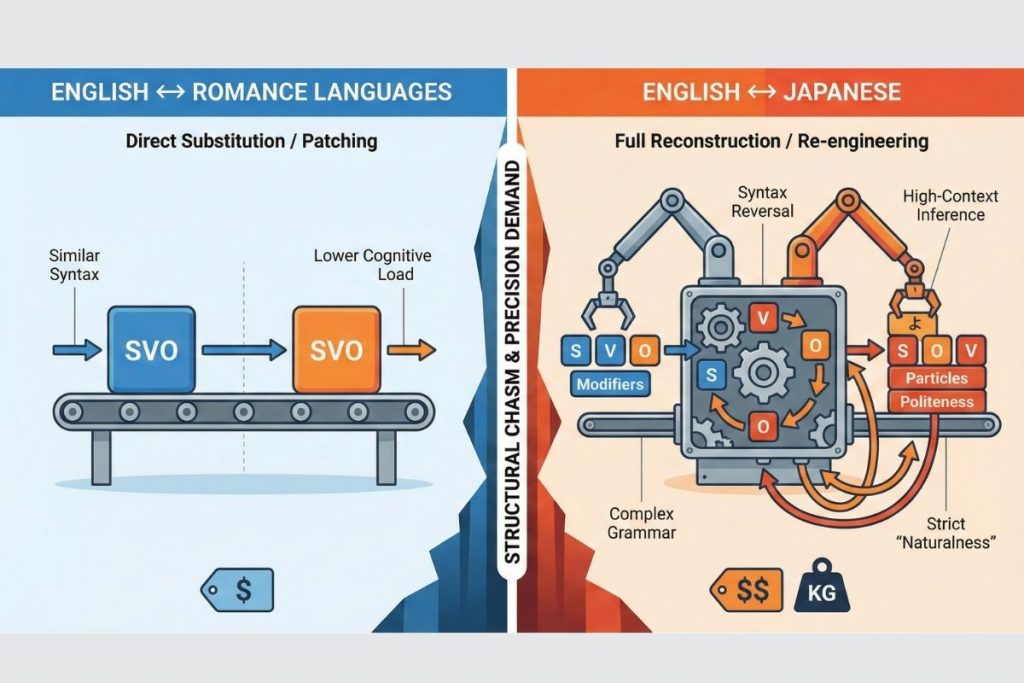
Western procurement managers often ask: “We pay $0.10 per word for Spanish. Why is the English to Japanese translation rate nearly double?”
This is not price gouging. It is a reflection of the immense structural distance between the languages and the specific “cost of precision” required to meet Japanese market standards.
To understand the price difference, one must recognize that English to Japanese translation is not a simple substitution task; it is a full reconstruction process.
(Reference:https://www.tdx.cat/bitstream/handle/10803/379824/TESI.pdf?sequence=1&isAllowed=y)
Reason 1. The Structural Chasm: Why “Re-engineering” is Required
European languages (like French, Spanish, or Italian) often share the same linguistic DNA as English. Japanese does not. This forces translators to perform heavy cognitive lifting to dismantle English logic and rebuild it for Japanese processing.
Syntax Reversal (SVO vs. SOV)
English follows a Subject-Verb-Object order (“I eat sushi”). Japanese follows Subject-Object-Verb (“I sushi eat”). This is not just a shuffle; it reverses the information flow. In English, the action (verb) is presented early. In Japanese, the verb comes last. A translator must read the entire English sentence, hold the structure in working memory, and reverse-engineer it to ensure the conclusion lands at the end.(Reference:https://aclanthology.org/2022.amta-wetpr.6.pdf)
Subject Handling (Explicit vs. Contextual)
English demands a subject (“I went to the store”). Japanese naturally omits subjects when the context is clear (“Went to store”). Translating English directly into Japanese results in a redundant, unnatural text (“I… I… I…”). Translators must actively decide what to delete. Conversely, from Japanese to English, they must invent subjects (Is it I? He? We?) by inferring context that isn’t on the page.(Reference:https://mt-archive.net/TMI-1995-Nakaiwa.pdf)
Modification Direction (Right vs. Left Branching)
English adds detail to the right (“The book that I bought yesterday”). Japanese piles detail to the left (“Yesterday-I-bought book”). Translators must flip the logic of complex sentences entirely, preventing a linear, word-for-word translation workflow.
Morphology (Inflection vs. Agglutination)
English modifies words slightly (eat/ate). Japanese is “agglutinative,” gluing multiple meanings together. A single verb phrase like tabe-sase-rare-ta contains “eat + cause + passive + past” (was made to eat). Mapping these dense meaning-packets to English syntax requires unpacking and interpretation, not just dictionary lookups.(Reference:https://arxiv.org/html/2402.14411v1)
Grammar of Politeness (Register)
English uses words to be polite (“Please…”). Japanese embeds politeness into the grammar itself. Verbs change entirely based on who is speaking to whom (e.g., iu vs. moushiageru vs. ossharu for “to say”). A translator cannot simply translate the meaning; they must design the social distance of the text.(Reference:https://www.atlantis-press.com/article/125995437.pdf)
Summary
Because the linguistic “operating systems” are so different, English to Japanese translators cannot simply “patch” the code; they must rewrite it entirely.
Reason 2. The Cost of Precision: Why “Naturalness” is Expensive
In the Japanese market, an “unnatural” English to Japanese translation is synonymous with “low quality.” Unlike some markets where intelligibility is enough, Japanese readers have a low tolerance for “translationese.”(Reference:https://aclanthology.org/2020.eamt-1.17.pdf)
“Naturalness” = “Correctness”
In Japanese, a sentence can be grammatically correct but culturally wrong. The standard for quality involves extensive “smoothing” (editing) to ensure the text reads as if it were originally written in Japanese. This makes the “Editing” phase of TEP (Translation, Editing, Proofreading) significantly heavier than in other languages.
The “One-Character” Risk (Particles)
Japanese meaning is dictated by particles (single characters like wa, ga, ni, de). Changing one character can shift the meaning from “Subject” to “Object” or “Cause.” Since English doesn’t have equivalents for these, the translator must logically deduce the relationship between words. This precision work takes time.(Reference:https://pmc.ncbi.nlm.nih.gov/articles/PMC9637203/)
The Inference Burden
Because Japanese relies on high-context (what isn’t said is understood), translators often have to “guess” missing information (subjects, objects, gender) to create a complete sentence in English or to smooth out English into Japanese. This “inference” is a mental tax that slows down production speed.
Synonym Optimization
Japanese has a massive vocabulary with many synonyms for a single English concept (e.g., “consider” could be kento, seisa, kyogi, tsumeru, handan, etc.). Finding the exact word that fits the corporate tone requires a search process that is more exhaustive than in languages with fewer synonyms.
Conclusion
The premium you pay for English to Japanese translation is the cost of High-Context Reconstruction. You are paying for a professional to bridge a massive linguistic gap and to ensure your brand meets the exacting quality standards of the Japanese market.(Reference:https://www.tdx.cat/bitstream/handle/10803/379824/TESI.pdf?sequence=1&isAllowed=y)
Navigating the Pricing Models: Source Word vs. Target Character
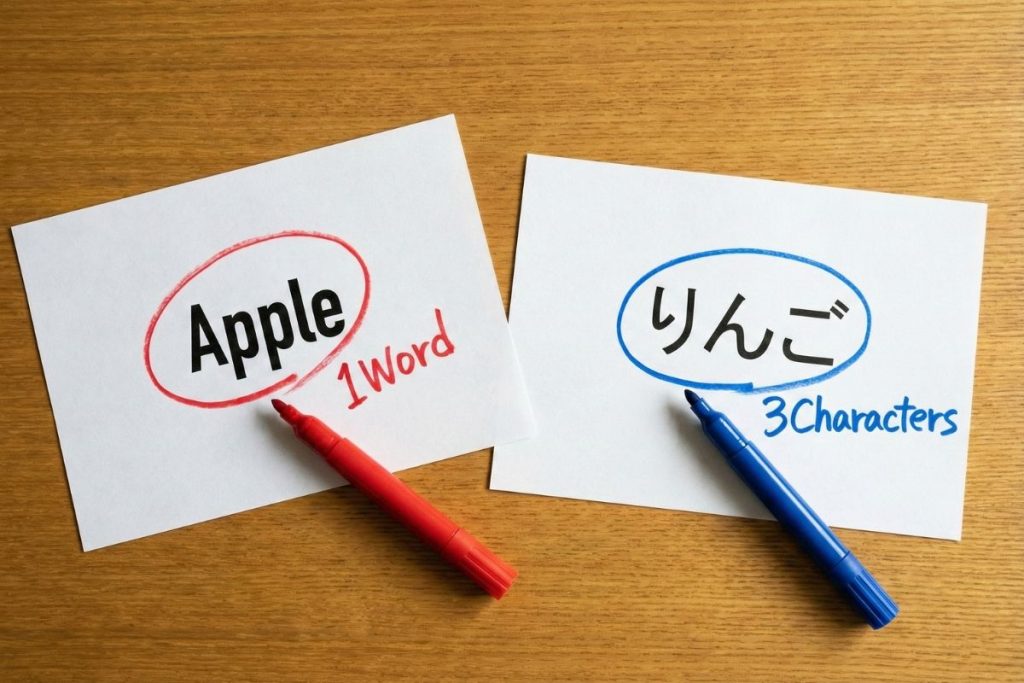
One of the biggest sources of friction in negotiations is the mismatch in pricing units.
- Western Standard: Per Source Word (English).
- Japanese Standard: Per Target Character (Japanese Moji).
The Conversion Heuristic
Since Japanese does not use spaces between words, agencies in Japan count “characters.” To make an apples-to-apples comparison between quotes, you must apply a conversion factor.
Formula: 1 English Word ≈ 2.0 to 2.5 Japanese Characters
Scenario: A domestic Japanese agency quotes you 12 Yen per character.
- Is this cheap?
- Math: 12 Yen × 2.2 (average ratio) = 26.4 Yen per English word.
- Converted to USD (assuming 1 USD = 150 JPY): ~$0.18 per word.
Warning:
Many Western buyers see “12” and assume it means “12 cents per word,” believing they have found a bargain. In reality, they are paying a standard premium rate. Always clarify the unit of measurement before signing a contract.
The AI Factor: Machine Translation Post-Editing (MTPE) Rates and Risks

In 2026, AI is unavoidable. However, for English-to-Japanese, reliance on AI carries specific risks that do not exist in other language pairs.
Why Japanese MTPE is Risky
AI engines (e.g., DeepL, Google Translate) struggle with subject omission in Japanese.
- English Source: “Open the file. Then, check the settings.” (Implicit subject: “You”)
- AI Error: The AI often guesses the wrong subject, sometimes translating it as “I check the settings” or “He checks the settings” because Japanese sentences often omit the subject entirely.
AI also struggles with keigo (honorifics). It might translate one sentence in a polite desu/masu tone and the next in a casual da/de aru tone, making your brand sound inconsistent.
Strategic advice:
If you choose MTPE to save costs (e.g., paying $0.12 instead of $0.16), demand Full Post-Editing by a native Japanese linguist who understands these AI pitfalls. Do not settle for Light PE for public-facing content.
Vendor Spotlight: Analyzing AtGlobal, Ltd.’s Value Proposition
In a market polarized between cheap AI ($0.06) and expensive legacy firms ($0.30+), AtGlobal, Ltd. (株式会社アットグローバル) positions itself in the strategic Affordable Premium tier.
The Rate: 30 JPY (approx. $0.20 USD)
AtGlobal, Ltd.’s standard rate for English-to-Japanese translation is 30 JPY per word.
The rate: 30 JPY per English source word (approx. $0.20 USD at 1 USD = 150 JPY). At 1 EUR = 160 JPY, this equals approximately €0.19 per word.
Why this represents high ROI:
- Transparent per-word pricing: They quote based on English source words, so you can estimate final cost before the project starts.
- TEP included: The rate includes Translation, Editing, and Proofreading; a second independent linguist checks the work. Many agencies that charge $0.12–$0.14 omit the second linguist to lower price, shifting quality risk to the client. AtGlobal keeps the safety net.
The Differentiator: “CQ Translation” (Cultural Intelligence)
AtGlobal markets its service as “CQ Translation®” — a workflow designed to address high-context issues.
Example of CQ in Action:
- Source: “We dominate the market with aggressive strategies.”
- Literal Translation: “Wareware wa shijo wo shihai shiteiru…” (Sounds like a military dictator or monopoly; very negative in Japan).
- CQ Translation: “We lead the industry with proactive initiatives.” (Conveys strength without arrogance, fitting Japanese corporate humility).
For marketing managers, paying $0.20/word for this level of nuance is significantly cheaper than paying for a PR crisis management campaign later.
Hidden Costs and How to Avoid Them

When budgeting, look beyond the per-word rate. The following hidden costs can inflate your final invoice by 20–50%.
Minimum charges
If you send a 50-word email, you will not be charged $10.00; you will be charged a minimum fee. Industry standard: $30–$60 (equivalent to ~400–500 words).
AtGlobal’s policy: minimum charge applies for jobs under 400 words. Tip: Batch small requests together; wait until you have 500+ words before sending a file.
Rush fees
Japanese translation takes time.
- A standard professional produces ~2,000 words/day.
- Rush: +20% to +30% surcharge.
- Express (weekend/overnight): +50% to +100%.
Rushing often means splitting the file among multiple translators, which can hurt consistency. Avoid rushing when possible.
Formatting and DTP (desktop publishing)
English text often expands or breaks layout when translated into Japanese. Japanese characters and line-breaking rules differ, so layout can break. Agencies charge DTP fees (approx. $5–$10 per page) to fix layouts in InDesign, PowerPoint, or Illustrator.
Tip: Provide editable source files (not PDFs) and ask whether simple formatting is included in the per-word rate.
Financial & Legal Advantages for Western Buyers

Procuring from Japan isn’t just about quality; there are tangible financial incentives.
1. The Consumption Tax Exemption (Export of Services)
Japan has a 10% consumption tax (JCT). Services provided by a Japanese business to a non-resident (foreign company) are generally tax-exempt. If you are a US or EU company contracting directly with a Japanese vendor, your invoice should not include the 10% tax — an automatic saving.
Action: Ensure your vendor classifies the transaction correctly as an export of services.
2. Direct USD Billing & Budget Certainty
While many domestic Japanese agencies strictly require payments in JPY—forcing Western clients to manage fluctuating exchange rates and foreign transaction fees—global-ready agencies like AtGlobal, Ltd. offer direct USD billing.
This simplifies the procurement process significantly. By locking in a fixed USD rate per word, your finance team eliminates currency volatility risk and avoids hidden banking costs. You gain budget predictability for the 2026 fiscal year without the administrative headache of cross-currency management.
3. Cumulative Cost Savings via Translation Memory (TM)
Working with a professional agency is an investment in linguistic assets, not just a one-off expense. Unlike ad-hoc freelancers, established firms utilize advanced Translation Memory (TM) technology to store every translated segment.
As your partnership matures, you are not charged the full rate for repeated phrases or sentences. This “TM discount” can reduce total localization costs by 15–30% over time while ensuring consistency. Legally, you retain ownership of this database, turning your translation expenditure into a reusable corporate asset.
Strategic Procurement: A Step-by-Step Guide

To secure the best “English to Japanese translation rate” without compromising quality, follow this 4-step procurement roadmap.
Step 1: Define Your Content Tiers
Don’t apply a “one size fits all” strategy. Map your content to the tiers discussed earlier.
- Tier 1 (High stakes): Marketing, Legal, UI. Action: Use AtGlobal, Ltd. (Human TEP). Budget $0.20–$0.25.
- Tier 2 (Medium stakes): Support articles, Technical Manuals. Action: Use Full MTPE. Budget $0.15–$0.18.
- Tier 3 (Low stakes): Internal forums. Action: Use Raw AI. Budget ~$0.01.
Step 2: Request a “Source Word” Quote in JPY
When contacting vendors, specify:
- “Please quote in JPY per English Source Word.”
- “Please confirm that TEP (Check/Proofreading) is included in this rate.”
- “Please confirm that Consumption Tax (10%) will be exempted as we are a foreign entity.”
Step 3: The “CQ” Test
Do not just ask for a free sample (typically 200-300 words). Test their cultural intelligence.
- The Test: Include a slogan, a joke, or a culturally ambiguous phrase in your sample text.
- Evaluation: If they translate it literally, reject them. If they ask clarifying questions or provide a creative adaptation (Transcreation), they are a Tier 3 partner worth the investment.
Step 4: Verify ISO Standards
Ensure the vendor aligns with:
- ISO 17100: Ensures the process involves a translator and a reviser.
- ISO 27001 (ISMS): Crucial for data security if you are handling customer data.
FAQ
- What is the standard turnaround time for English to Japanese translation?
-
Speed varies by quality tier. For professional human TEP, industry-standard output is approx. 1,500–2,000 words per business day per linguist. Agencies need additional time for project setup, file prep, and QA.
For example, AtGlobal typically sets 4 business days for a 2,000-word project to allow for CQ review. Raw AI or Light MTPE can process 3,000+ words daily, but faster delivery often compromises keigo and tone.
- Is there a minimum charge for small projects?
-
Yes. Most agencies apply a minimum charge to cover admin overhead. In Japan, typical minimums range from ¥3,000 to ¥10,000 ($20–$65 USD), equivalent to ~400–800 words.
AtGlobal applies a minimum charge equivalent to 400 words for English source text under that volume. Tip: Consolidate small requests.
- How much extra do “Rush Services” cost?
-
Rush surcharges are typically +20% to +30%; express/overnight can be +50% to +100%. Splitting files among translators to meet deadlines can harm consistency; ensure a single editor performs a final harmonization.
- Do Japanese agencies offer free trial translations?
-
Yes. Reputable boutique agencies often provide a free test translation of 200–300 words for prospective corporate clients. Use marketing or brand messaging in the sample to test transcreation ability.
- How do international payments work with Japanese vendors?
-
Modern Japanese agencies accept credit cards, PayPal, or Stripe. Verify tax exemptions: services exported to non-resident foreign corporations are generally 0% for consumption tax. Confirm whether the quote is tax-excluded.
- Does the rate include formatting or DTP (Desktop Publishing)?
-
Generally no. Per-word rates cover linguistic work only. DTP is usually charged separately ($5–$10/page). Provide editable files and confirm what formatting is included.
Summary : English to Japanese translation rate
- English-to-Japanese translation rates are higher due to linguistic complexity and limited talent supply.
- The 2026 market is split into clear tiers from raw MT to premium human TEP.
- Cultural nuance and tone make Japanese translations riskier to automate.
- Word-vs-character pricing differences often confuse Western buyers.
- High-context communication requires adaptation, not literal translation.
- Mid-tier boutique agencies like AtGlobal offer strong ROI with full TEP.
- Minimum fees, rush charges, and DTP costs can significantly affect budgets.